


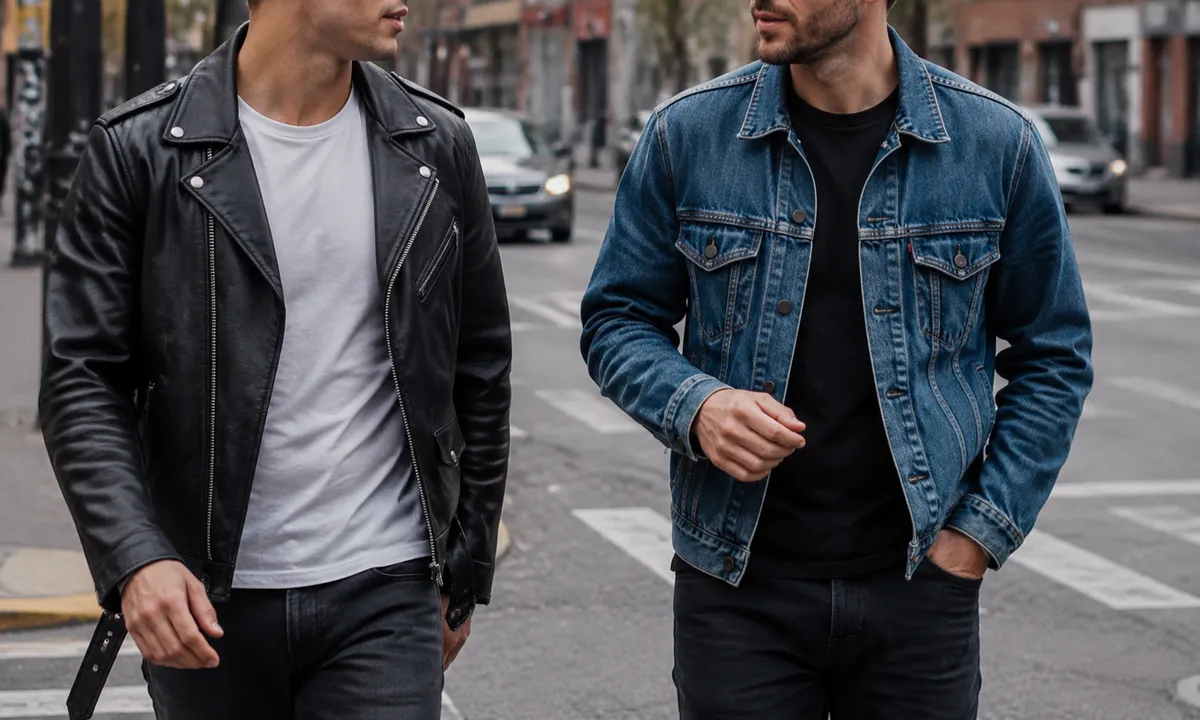
Two jackets. Both casual. Both built for the same approximate slot in a wardrobe: over a t-shirt, under nothing, on a weekend or a night out or a flight you didn’t want to dress up for. And yet the choice between them is rarely interchangeable, because they come from completely different places and pull an outfit in completely different directions.
Leather and denim are the two great outerwear fabrics of the twentieth century, and both became icons for the same basic reason: rebels wore them before anyone else did. After that, the mainstream caught up, the rebel edge softened, and what remained was just good design. Sturdy, adaptable, and proven over decades of actual use.
The question worth asking isn’t which one is better in the abstract. It’s which one does what you need, and what you’re actually getting when you reach for either one.
What a Leather Jacket Actually Does to an Outfit
A leather jacket adds weight, in every sense. The physical weight is real: a well-made one in full-grain cowhide sits noticeably on the shoulders, and that heft reads as presence. It changes the silhouette. It sharpens it. Put one over a plain white tee and dark jeans and you’ve got something that registers as intentional even if you spent thirty seconds picking it out.
The leather jacket’s currency is edge. It borrows from the moto tradition, from Brando on a motorcycle, from every rock band that ever needed a look. That history is baked into the garment itself, into the hardware and the asymmetric zips and the way the collar can go up. You don’t have to know the history for it to work. The jacket does the communicating on its own.
That same quality is also its constraint. Leather jackets are hard to make light. They resist casualness. Throw one over a floral dress and it reads as a deliberate contrast move. Wear it with a hoodie underneath and it starts to fight itself. The jacket tends to dominate, which means everything else in the outfit either has to defer to it or push back against it on purpose.
Fit is more punishing in leather than in almost any other outerwear. Leather doesn’t drape or compensate the way a cotton canvas or a nylon shell might. A shoulder that lands a half-inch too wide looks wrong immediately and stays wrong. A sleeve that’s too long bunches at the wrist in a way that reads as cheap rather than relaxed. When you find a leather jacket that fits, it fits. When one doesn’t, no amount of styling corrects it.
What a Denim Jacket Actually Does to an Outfit
A denim jacket moves differently. It’s lighter, more forgiving in the shoulders, and it sits on top of an outfit without taking it over. Wear one over a floral shirt, a striped tee, a heavy knit sweater, a button-down that got too warm: the denim jacket absorbs all of it without complaint. That versatility is genuine, and it’s the jacket’s main argument for itself.
Denim also ages well in a different way than leather. A leather jacket that hasn’t been conditioned can crack or stiffen; one that’s been poorly stored loses its shape. A denim jacket that’s been worn hard just fades and softens and develops a worn-in character that actually improves with use. The texture becomes more interesting. The color breaks in an appealing way. Vintage denim jackets are sought after specifically because of this: the ones that have been lived in look better than the ones fresh out of a box.
The denim jacket’s tone is casual by default. It reads as easygoing, approachable, low-stakes. That’s not a limitation so much as a specific register. For most off-duty situations, approachable is exactly what you want. The denim jacket doesn’t announce anything. It just sits there, doing its job, keeping you from being cold at the bar or on the walk to the restaurant.
Where denim can get lost is in dressing up. Wear a denim jacket over a shirt and chinos and you’re sending the whole outfit back toward casual. The jacket caps the formality ceiling at a certain level, and that ceiling is lower than leather’s. A leather jacket can push an outfit toward dressed-up-in-a-different-way. A denim jacket usually can’t.
The Care and Longevity Gap
Leather requires attention. A good leather jacket needs to be conditioned periodically, stored somewhere it can breathe rather than compressed in a closet, and kept away from sustained moisture. Left totally alone for years, even a quality jacket can dry out and become brittle in places. This isn’t a catastrophe; it’s just a maintenance relationship. The jacket asks something of you.
In exchange, a well-maintained leather jacket can last decades without looking worse for it. The patina it develops, the small scuffs and the softening along the collar and cuffs, those aren’t damage. They’re a record of use. A ten-year-old leather jacket that’s beencared for is often more appealing than a new one, just broken in and shaped slightly to the person who wore it.
Denim demands almost nothing. Machine-wash it when it needs it, hang it to dry, done. There’s no conditioning, no special storage, no seasonal ritual. For anyone who doesn’t want to think about their clothes beyond wearing them, this matters. The denim jacket wins on pure ease of ownership without any contest.
Durability-wise, both will outlast most of what’s in a wardrobe if they’re bought at a reasonable quality level. The failure modes differ: a cheap leather jacket peels and cracks at the coating because it was bonded synthetic material rather than real hide; a cheap denim jacket pills and fades unevenly and loses structure quickly. The price floors for each to perform well are different, with leather requiring more investment to get past the threshold where it starts to behave like the real thing.
Price, Investment, and What You’re Actually Buying
A serviceable denim jacket from a reliable mid-range brand sits somewhere in the range of forty to a hundred dollars. A genuinely good one in heavyweight denim with solid construction costs more, but you can find it for under two hundred without much trouble. The category has a wide, accessible price range and the quality doesn’t fall off a cliff at the lower end the way it does with leather.
Leather is a different proposition. Below a certain price point, what’s being sold isn’t full-grain or top-grain leather at all; it’s bonded leather orcoated synthetic material that looks the part in a photo and degrades quickly in real life. The peeling and flaking that seems to happen to leather jackets isn’t leather behaving badly; it’s the coating on cheap alternatives delaminating. Real leather doesn’t do that. Getting past that threshold generally means spending at least two to three hundred dollars, and a lot of the leather jackets that will genuinely last a lifetime cost considerably more than that.
The honest framing is that a leather jacket, bought right, is a decade-plus investment. A denim jacket is a much lower-stakes purchase that can still serve well for years. Those are different buying decisions for different situations, and the right answer depends less on taste than on what someone is actually prepared to spend and maintain.
Seasonal Range and Practical Overlap
Neither jacket is a four-season garment without some help. Both are at their best in spring and fall, in that window where the temperature sits somewhere between a light shirt being enough and a real coat being necessary. Leather handles cold slightly better than denim because it blocks wind effectively, but neither one will carry you through a genuine winter without layering underneath.
In summer heat, a leather jacket is genuinely uncomfortable, and the look of wearing one in high heat starts to read as posturing rather than style. Denim breathes marginally better but isn’t a summer jacket either. In the rain, leather resists water well (real leather sheds light moisture without damage), while denim absorbs it and takes time to dry. For anyone living somewhere with frequent rain, that practical difference matters more than any aesthetic consideration.
The jackets also layer differently. Denim over a chunky knit or a heavy hoodie works fine because the fabric has some give. Leather over a thick mid-layer can feel constricting and moves awkwardly because the hide doesn’t stretch. For winter layering, a denim jacket works better as the outer shell, while leather stays cleaner when worn closer to the body over lighter layers.
The Style Calculus That Actually Decides It
Here’s the real split: a leather jacket is a centerpiece, and a denim jacket is a supporting player. If the goal is to let an outfit speak and just provide cover from the cold, the denim jacket does that without interrupting anything. If the goal is to arrive wearing something with presence, something that signals a particular kind of confidence or aesthetic commitment, the leather jacket does that and the denim one can’t match it.
Most wardrobes that have room for both will use them differently, almost without thinking about it. The denim jacket goes on during the day, for errands and casual plans, with whatever is already being worn. The leather jacket gets chosen for specific occasions: a concert, a dinner where the dress code is ambiguous, a night where the goal is to look like you made a decision.
For someone building a wardrobe from scratch, or working within real constraints, the denim jacket is the more practical first choice. It does more, costs less, and requires nothing. The leather jacket is the one worth saving for, because when it’s right and it fits and it’s real, it changes the character of everything else in a closet. It earns its place in a way that not many pieces do, and once it’s there, it doesn’t leave.