


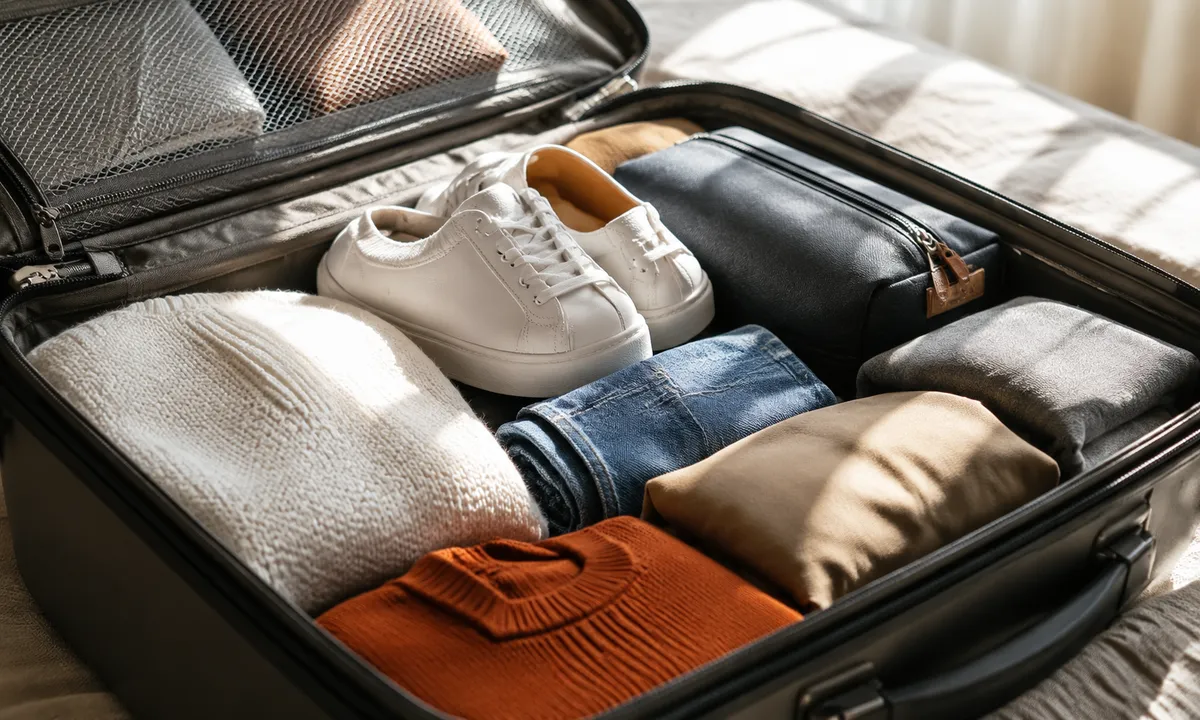
Forty liters is a hard constraint. No checked bag, no overflow tote, no “just this once” personal item that is obviously a second suitcase. Forty liters is the number many serious carry-on travelers live and die by, and inside that volume, the question of whether style and comfort can coexist stops being philosophical. It becomes spatial.
The short answer is yes, but it requires letting go of a few assumptions about what both words mean.
Why the Tension Feels Real
Comfort, in travel packing, tends to mean: a separate pair of shoes for every occasion, a thick hoodie folded in thirds, the jeans that take up most of one side of the bag on their own. Style tends to mean: things that wrinkle if you so much as look at them, structured blazers that require hanging, and dress shoes with hardware that destroys everything around them. Put those two definitions together, and yes, a carry-on cannot hold them both. But those definitions are a product of habit, not logic.
The traveler who insists on packing four pairs of jeans for a five-day trip and then complains that there is no room for anything elegant is solving the wrong problem. The actual problem is fabric selection, and almost everyone arrives at it late.
Fabric Does Most of the Work
A merino wool crewneck weighs somewhere around 200 grams, compresses to roughly the size of a paperback, does not hold odor the way synthetics do, and looks deliberate on a body rather than athletic. It layers under a blazer. It works alone at a casual dinner. It survives being balled up in an overhead bin and emerges needing no more than a few minutes of hanging to lose its creases. That single garment is doing the work of two or three items that take up twice the space and require more care.
Wool-cotton blends and ponte fabric behave similarly. A ponte trouser holds its shape across a transatlantic flight in a way that raw denim simply does not, and it reads as put-together in most contexts where a meeting or a dinner requires something sharper than jeans. The material itself is making the style-comfort tradeoff disappear, rather than forcing a choice between them.
Linen is more complicated. It breathes, it photographs beautifully in warm destinations, and it is honest about its wrinkles in a way that reads as intentional if the rest of the outfit is considered. But it requires knowing the context. A linen blazer in Lisbon in July works. The same blazer going directly from a red-eye into a presentation in an air-conditioned office does not.
The Shoe Problem, Addressed Honestly
Shoes are where carry-on packing most commonly breaks down. They are heavy, they are rigid, they kill volume, and most people bring too many of them. The honest number for a trip under ten days is two pairs. Wear the bulkier pair through the airport. Pack the lighter, more versatile one.
A white leather sneaker in a clean, minimal silhouette does genuine heavy lifting here. It works with tailored trousers at a smart-casual dinner, with slim jeans on a walking day, and with linen in the heat. It is not the most elegant solution imaginable, but it is a real one that real people deploy successfully. The alternative, the classic low Chelsea boot in a neutral tan or black, covers similar ground with a slightly dressier ceiling and handles cold destinations better. Neither choice is exciting. Both choices mean everything fits.
Heels are the honest exception. A single pair of low block-heeled mules or kitten heels can be packed efficiently and genuinely elevates an outfit. More than that is asking the bag to absorb a weight and volume penalty that eliminates other options.
Capsule Thinking vs. Outfit Thinking
The traveler who packs outfits, meaning pre-assembled combinations where the blue shirt goes with those pants and that jacket, runs into trouble fast. One item gets stained or the weather shifts and the whole combination is useless. The traveler who packs pieces, meaning items that each connect to at least three others in the bag, moves through a trip with actual flexibility.
This is the capsule principle, and while it gets mentioned in every packing article ever written, it is worth stating clearly because most people understand it abstractly and ignore it in practice. The test is simple: before packing any item, count how many other items in the bag it works with. If the answer is one, reconsider. If the answer is zero, leave it.
A well-built carry-on wardrobe for five days might contain: two trousers in neutral tones, three tops in colors that all work with both trousers, one layer (a blazer or a quality zip-up depending on the climate), one dress that functions as both a daytime and evening option with the right shoes, and the two pairs of shoes. That is eleven items and the math produces significantly more than eleven outfits.
What Actually Gets Worn Twice
Everyone in the packing conversation talks about re-wearing, and almost everyone also quietly feels resistant to it. The social anxiety around wearing the same thing twice in front of the same people is real, even if it is mostly self-generated. A few observations that help.
Nobody is tracking outfits on a trip the way people track them at home or on social media. A blazer worn Monday evening and again Thursday evening in a different city, or even at a different restaurant in the same city, is not memorable to anyone but the person wearing it. Accessories are what people notice and remember: a scarf, a bag, earrings that catch light. These are also among the lightest and most packable items in a wardrobe.
Bringing two silk scarves instead of two extra tops is a trade that wins on every axis. Volume stays low. The outfit reads different each time. The fabric is forgiving to pack.
The Carry-On Itself Has Opinions
Packing organization affects wearability more than most people expect. Clothes that arrive compressed into a formless mass require more recovery time than clothes that traveled flat or rolled deliberately. Packing cubes do real work here, and the better ones are slightly structured so they do not just squeeze everything into a brick.
The layout inside the bag matters too. Shoes go on the bottom, near the wheels on a hard-sided roller, so their weight rests where the bag is designed to carry it. Heavier items in general stay low. Anything that wrinkles badly goes last, closest to the lid, where it faces the least compression. This is not a revelation, but most people pack by stuffing rather than by placement, and they pay for it in wrinkles.
A hanging toiletry bag eliminates the fumbling and repacking that erodes every hotel room morning and adds nothing to wearable volume. It is one of the few packing accessories that actually earns its keep.
The Blazer Question
A well-cut blazer is the most contentious carry-on item in this conversation. Structured blazers in heavy wool do not pack well. They emerge looking slept-in, and no amount of hanging fixes a collar that has been compressed for six hours. But an unstructured blazer in a medium-weight fabric, something in a cotton-linen or a soft suiting material, packs flat and recovers quickly. Some travelers wear it on the plane to avoid packing it at all, which works and is also a genuinely comfortable option for air travel.
The blazer earns its carry-on weight when it functions as the anchor of the most elevated outfit in the bag, the one required for a dinner reservation or a theater night or a meeting. One blazer, used that way, justifies more space than a second pair of casual trousers.
Where the Effort Actually Goes
Packing a carry-on with both style and comfort is mostly a planning problem, not a space problem. The people who do it well spend time before the trip, sometimes a full hour, laying everything out, testing combinations, and cutting ruthlessly. The people who struggle with it pack quickly and reactively, grabbing what feels safest, which usually means too much of the comfortable and not enough of the considered.
The reward for doing that planning work is significant. A bag that comes off the carousel, or out of the overhead bin, with everything already sorted means no checked bag fees, no waiting at baggage claim, no anxiety about a lost suitcase on a tight connection. It also means that every item in the bag is there for a reason and connects to everything around it. That is not a minor logistical win. It changes the texture of the trip itself, the feeling of arriving somewhere with exactly what is needed and nothing that is not.