


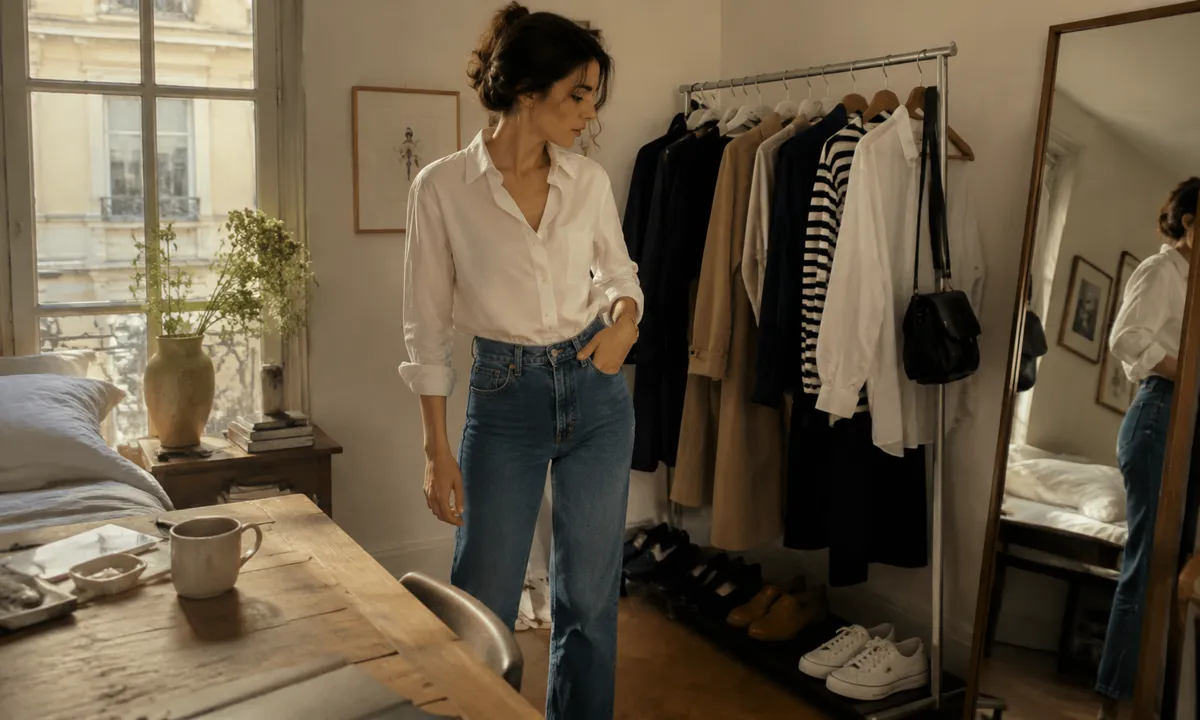
Thirty days. One rule: nothing that would look out of place on a woman who got dressed in 1962, or 1985, or any other decade that has since been absorbed into the permanent wardrobe canon. No trend pieces, no logomania, no anything that required a runway moment within the last five years to exist. Just the clothes that have been called classic for long enough that the label has stopped meaning anything specific and started meaning something true.
The experiment started because of a white shirt. Not a particular white shirt, just the category of it. The idea that a crisp white button-down is always appropriate, always elegant, always correct. It shows up in every style guide ever written. It has its own mythology. So the question became: is that actually true, or is it one of those things that gets repeated until repetition becomes proof?
The short answer is that it is true. The longer answer is that the month turned out to be about something else entirely.
What “Classic” Actually Means When You Have to Live in It
Before the first week was out, a working definition had to be settled on. Classic does not mean expensive. It does not mean conservative. It means structurally stable: the garment’s silhouette, fabric, and purpose have remained recognizable across at least two or three generations without requiring a trend cycle to justify wearing it. A trench coat qualifies. A midi wrap dress qualifies. A merino crewneck qualifies. A straight-leg dark-wash jean qualifies, though this one took some convincing because jeans feel too casual to call classic, and then you remember that Levi’s has been making essentially the same 501 since the 1870s.
The items that got ruled out were the interesting ones. A pair of wide-leg trousers in a muted linen: classic fabric, classic color, but the silhouette is having a moment right now, which is different from having always been around. A leather loafer with a chunky platform sole: the loafer is classic, the platform is a decision made sometime around 2022. These distinctions sound pedantic until you are standing in a closet at 7 in the morning and they suddenly feel urgent.
The wardrobe that passed the test was smaller than expected. Twelve pieces, which is not a capsule-wardrobe marketing number but just what was already owned that qualified. A navy blazer with real horn buttons. Three white shirts (two Oxford cloth, one poplin). A camel turtleneck. Two pairs of straight dark jeans. A grey flannel trouser. A trench. A silk blouse in cream. A striped Breton top, the kind that has existed in more or less the same form since the French navy standardized it in the 19th century. A pair of plain white leather sneakers. A cognac leather belt.
The First Week Felt Like a Uniform, and That Was Not a Complaint
Getting dressed in the morning took less time. Significantly less. The decision load was almost entirely removed because every item worked with every other item, and the question was never “does this go together” but only “what do I need today.” Blazer and flannel trousers for a meeting. Breton top and straight jeans for a Saturday. Turtleneck under the blazer when it got cold. The combinations were not exciting but they were all correct, and correct has a value that is easy to forget until you are no longer spending mental energy on it.
The uniform feeling was real, and it came up in conversation. A colleague said the outfits all looked “put-together,” which is a compliment that also means they were a little samey. Fair. Someone else said “you look like you work at a French magazine” three days in a row, which after the third time stopped feeling like a compliment and started feeling like a category. Getting stuck in a category is the risk nobody mentions in the classic-wardrobe literature.
Where the Clothes Actually Held Up
A work dinner in week two. The silk cream blouse, the grey flannel trousers, the cognac belt. Nothing about the outfit required explanation or adjustment. It read as dressed-up without being costumed. Nobody at the table was visibly thinking about what was being worn, which is the exact goal of most formal dressing and also the hardest thing to achieve with trend-forward clothes that ask to be noticed. The blouse had been bought secondhand for less than twenty dollars and it looked like it cost ten times that, which is the argument for quality fabric in two sentences.
A child’s birthday party in week three. The Breton top and jeans, white sneakers. Again: zero effort, completely appropriate, no one gave it a second thought. This is a low bar but it is a bar that a surprising number of outfits fail. The classic pieces did not fail it once in thirty days, across a range of contexts from a funeral to a farmer’s market to a last-minute video call where only the top half was visible. The navy blazer alone appeared in fourteen of the thirty days. It earned its square footage.
Where They Did Not
A friend’s birthday dinner at a restaurant that had a playlist and a neon sign and a menu printed on brown kraft paper. Everyone else was wearing something with an attitude: a slip dress over a long-sleeve, a leather jacket with interesting hardware, something brightly colored. The camel turtleneck and straight jeans were fine. More than fine, technically. But the room had a frequency and the outfit was not on it. There is a kind of social dressing that is about participation, about showing up in the vernacular of the moment, and classic clothes opt out of that by design. Opting out is sometimes exactly right. That night it felt like arriving at a party speaking a language everyone understood but nobody was using.
The other failure was personal and harder to articulate. Around day eighteen, the outfits started to feel less like choices and more like a default. The whole point of classic clothes is that they do not require you to think, but thinking about clothes is sometimes how a person locates themselves on a particular day. A bright color in a difficult week. Something a little strange on a day when strange feels honest. Classic clothes do not offer that. They are, by definition, mood-neutral. That stability is a feature until it starts to feel like a ceiling.
The Cost Question, Answered Honestly
The pieces used in the experiment ranged from a $14 secondhand silk blouse to a $380 trench coat bought four years ago. The trench has been worn roughly 200 times. The per-wear math is embarrassingly good, which is the argument the investment-dressing people always make, and it is a correct argument. It is also an argument that requires having the $380 available in a lump sum, which is a real constraint and one that the investment-dressing conversation tends to gloss over with a breezy “buy less, buy better.” Buying better is easier when buying less means buying at all.
What is genuinely true regardless of budget: the secondhand market for classic pieces is deep and cheap because classic pieces are always in supply. Nobody is waiting for a Brooks Brothers Oxford shirt to go out of style so they can unload it. The thrift store equivalent of trend dressing is picked over immediately and dated within a year. The thrift store equivalent of a navy blazer or a merino crewneck is almost always there, often barely worn, because these clothes get donated when a person clears out a closet and not because they fell apart or fell from favor.
What Day 30 Actually Looked Like
The last outfit of the month was the white Oxford shirt, the straight dark jeans, the white sneakers, and the navy blazer. It was the combination most worn during the thirty days, by a significant margin. It was not a statement. It was not interesting. It took four minutes to put together and looked like a person who had their life in reasonable order, which on most days is the correct impression to give.
The month’s real finding was not that classic clothes are good (they are) or that they are sufficient (they are not, entirely). It was that the question of what to wear is two separate questions wearing the same coat: one about function, about being dressed appropriately and with some ease, and one about expression, about showing up in the world as a specific person on a specific day. Classic clothes answer the first question nearly perfectly. The second question, they mostly leave alone. And for some people, on most days, that is enough. On the days when it is not, the Breton top will be there, and so will the neon-sign restaurant, and the decision will have to be made again.