


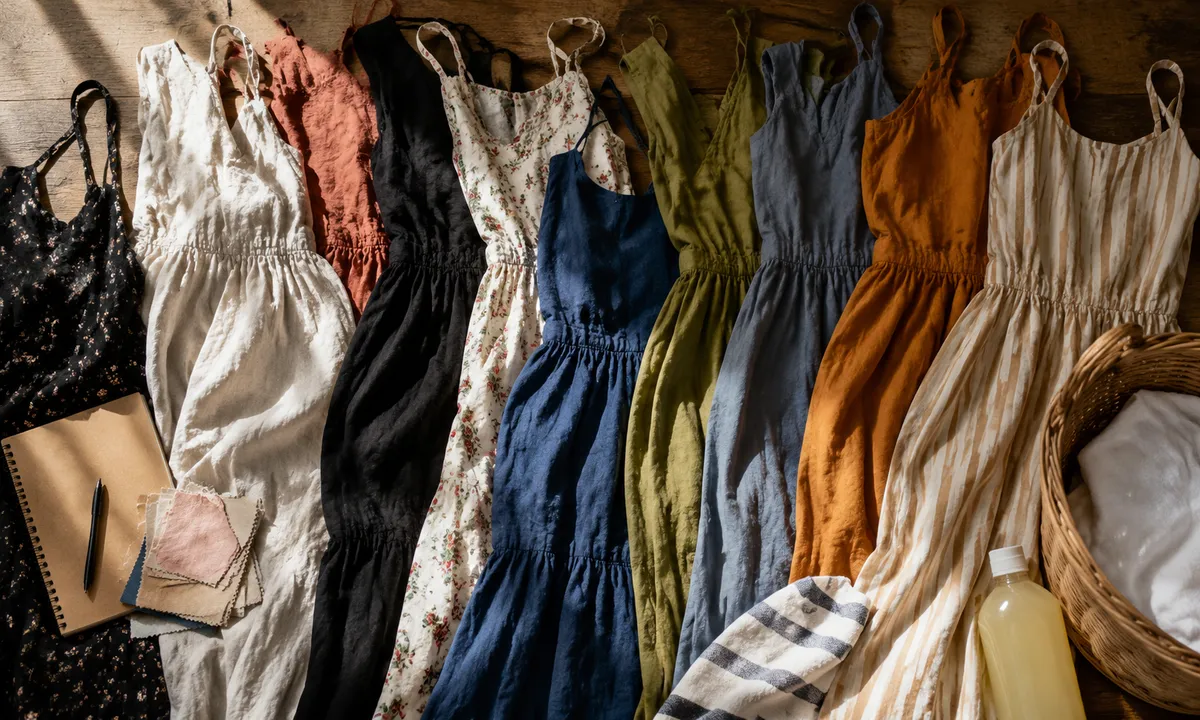
Four weeks, eleven dresses, and one very patient laundry routine. The test was simple: wear each fabric long enough to stop noticing it, then notice it again when something went wrong. Linen wrinkled in the car. Rayon clung in the humidity. Polyester did things near a food truck that cannot be undone. By the end of July, the differences between fabrics were not theoretical. They were in the fabric itself, stiff from salt or soft from washing, and they were on the body that had been living in them.
A maxi dress is a specific commitment. It covers more surface area than almost any other garment a person wears voluntarily in summer, which means the fabric’s relationship to heat, sweat, and movement plays out at scale. A slightly stiff weave that feels fine on a knee-length hem becomes oppressive when it wraps both legs for eight hours. This is the thing most fabric comparisons miss: they describe how something feels in a dressing room, standing still, in air conditioning. That is not the test.
Linen: The One That Earns Its Reputation
Linen’s case for summer is not complicated. The fiber is hollow, which means air moves through it rather than getting trapped against the skin. After a full day outside, a linen maxi dress feels noticeably less suffocating than any of the synthetic options tested, and significantly cooler than the rayon blends. The trade is obvious and real: wrinkles. Not gentle wrinkles. Structural ones, the kind that form at the hip after sitting for twenty minutes and stay there for the rest of the day.
Whether that matters depends entirely on context. For a farmers market or a beach town or anywhere the aesthetic is deliberately relaxed, linen wrinkle is practically a feature. For an office, a dinner, anything that requires looking assembled, it becomes a problem without a solution short of keeping the dress hung until the moment you leave the house.
The two linen dresses tested were a 100 percent linen and a linen-cotton blend at roughly 55/45. The blend wrinkled less and moved more softly. The pure linen ran slightly cooler and washed back to something close to new after each cycle. Both held up across repeated washing without the color degradation that showed up in other fabrics by week three.
Rayon and Viscose: Cool Until They Aren’t
Rayon (sold as viscose in most European sizing) has a reputation for being a breathable, plant-derived alternative to synthetic fabrics. The reputation is partly earned. Fresh from a wash, a rayon maxi feels genuinely light, it drapes beautifully, it photographs well, and for the first few hours of wear it delivers on the coolness promise. The problem arrives around hour four in direct sun or sustained humidity.
Rayon absorbs moisture readily, which is the same property that makes it feel soft and cool when dry. When it absorbs sweat rather than drawing it away from the body, the fabric becomes heavy and starts to cling. On a maxi dress, that clinging happens across the full length of both legs. One of the rayon dresses tested, a flowy challis weave, went from effortless to visibly damp around the thighs by mid-afternoon on a 91-degree day. The cling itself is uncomfortable. The visibility of it is worse.
Rayon also has a durability problem that shows up fast. Two of the three rayon pieces tested showed signs of pilling or stretching at stress points (waistband, side seams) within three weeks of regular washing. Hand washing extends the life considerably, but hand washing a maxi dress after every wear is a significant ask.
Cotton Lawn and Voile: The Underrated Options
Cotton lawn is woven tightly from fine-combed cotton, which gives it a smooth, almost silky hand feel and enough structure to hold a hem cleanly without bulk. Cotton voile is slightly more open in weave, sheerer, and even lighter. Both are genuinely breathable in a way that polyester-cotton blends never achieve, and both launder well in a machine without the structural damage that rayon accumulates.
The lawn dress tested was the most consistently comfortable piece across the entire month. It wrinkled less than linen but more than polyester, sat in the range that reads as casual rather than sloppy, and on the hottest days of the test it remained the one garment that did not produce the specific misery of fabric sealing itself to the back of the knee while walking. That detail sounds small. After three weeks of summer testing, it felt significant.
Voile requires more consideration. The sheerness on a maxi means lining is essentially mandatory, and a lined voile dress is only as breathable as its lining fabric. A cotton voile lined in polyester satin defeats the entire purpose. The voile dress that worked best in testing was lined in cotton batiste, which added minimal heat but preserved the modesty that makes it wearable anywhere.
Polyester and Poly Blends: The Honest Assessment
Polyester has been selling itself to summer shoppers for years on the basis of wrinkle resistance, ease of care, and the word “breathable” printed on tags that do not explain what that word means for a petroleum-derived fiber. Wrinkle resistance: accurate. Easy care: accurate. Breathable: not in any meaningful sense when compared to natural fibers in sustained heat.
The polyester maxi dresses in this test looked crisp from morning to afternoon. They held their shape through a full day of activity and survived a medium-heat machine wash without any dimensional change. On a 78-degree overcast day, the performance gap between polyester and linen narrowed to nearly nothing. On an 89-degree afternoon with direct sun and walking, the gap reopened and stayed open. Polyester traps body heat. At maxi length, that trapped heat extends over more of the body than it does in a shorter garment, and by late afternoon the sensation is something between wearing a mild compress and sitting too close to someone on public transit.
Moisture-wicking polyester, the kind used in athletic wear, performed slightly better on temperature management but introduced a different problem: the aesthetic of athletic fabric reads awkwardly in a maxi silhouette. It works for a beach coverup or a casual resort situation. Worn anywhere that requires looking even marginally intentional, it sits wrong.
Tencel and Lyocell: The Technically Correct Choice
Tencel is a brand name for lyocell fiber, made from wood pulp through a closed-loop process. The fabric community talks about it often as the ideal middle ground: the drape and softness of rayon without rayon’s durability issues, the moisture management of cotton without the weight of a dense cotton weave. After a month, the sales pitch holds up more than most.
The Tencel maxi dress tested was the single piece that produced no complaints across any category. It stayed cooler than rayon over a full day, wrinkled less than linen, dried faster than cotton, and showed zero pilling or stretch distortion after four weeks of regular machine washing. The only honest caveat is price. Tencel garments consistently run higher than comparable rayon or polyester pieces, and the selection at most mid-range retailers is narrower, particularly in maxi lengths.
What the Blends Actually Do
Most dresses on any rack are blends, and blends are complicated. A linen-cotton blend generally captures the best of both and little of the worst. A rayon-polyester blend captures polyester’s durability problems alongside rayon’s humidity problems, which is an odd combination to engineer into a summer dress but a common one. A cotton-polyester blend below 50 percent cotton starts behaving more like polyester than cotton by the end of a hot day.
Reading a label takes about four seconds. A tag that says “52% polyester, 45% rayon, 3% spandex” is telling a specific story about how that dress will feel at 3 p.m. in August. The spandex is for stretch and recovery. The rayon willcling after enough humidity. The polyester will hold the shape and trap the heat. That combination might be exactly right for someone who needs the stretch and is mostly indoors. For someone walking outside for hours in high summer, it is a harder choice to defend.
Weight, Weave, and the Detail Everyone Skips
Fabric type is the starting point, but weight and weave structure matter just as much in practice. A heavyweight linen is cooler in fiber content than a lightweight polyester but can feel hotter when the weave is dense enough to block airflow. A loosely woven cotton cheesecloth dress lets air move freely but can feel scratchy against bare skin by the end of the day. The cotton lawn that outperformed expectations did so partly because of its weave density: fine enough to feel smooth, open enough to let heat escape.
Color also enters the equation at maxi length in a way that rarely gets mentioned. A dark linen absorbs more solar heat than a pale one of identical weight. Over a full afternoon outdoors, that difference is measurable in comfort, not just aesthetics. The ivory cotton lawn dress and the dark navy rayon dress tested under identical conditions on the same day. The rayon absorbed more moisture and the navy absorbed more solar radiation, and by 4 p.m. the comparison had become a fairly blunt argument for rethinking the navy rayon entirely.
The best single fabric for a summer maxi dress is Tencel if the budget allows, cotton lawn if it doesn’t, and a linen-cotton blend if the occasion tolerates wrinkles. Everything else involves a tradeoff that becomes more pronounced as the temperature rises and the hem stays long. The dress that looks effortless is usually the one that made an honest decision about fabric at the start.