


The Posture Effect Nobody Mentions
This one is harder to quantify but hard to ignore after a week. Wearing a structured garment with a real waistband changes how a person carries themselves. Sweatpants allow a slump that cargo pants simply do not accommodate as easily. The structure is mild, not restrictive, but it is present. Standing in cargo pants feels slightly more upright, more deliberate, without any real effort.
Whether that matters depends on what a person is doing. For a day spent on thecouch, the sweatpant slump is the entire point. For a day that moves through several different environments, that gentle uprightness turns out to be a net positive: less adjustment when walking into a store, less awareness of how you look when you stand up from a chair in public.
What Sweatpants Do That Cargo Pants Cannot
After seven days, the sweatpants went back on and the relief was immediate and specific. The waistband released. The fabric draped rather than held. The warmth was different, softer, more even across the leg. For the first hour of a morning, when the body is still deciding what it is doing, sweatpants remain the most comfortable thing a person can put on their lower half while still being dressed.
Cargo pants do not replicate that. They offer a different contract: more structure, more utility, more versatility in where you can go in them. The trade is real. Anyone who claims cargo pants are just as comfortable as sweatpants is either wearing a very forgiving cut or is not paying attention to what their body is doing.
The week made one thing clear: the choice between them is not really a question of which is better. It is a question of what a given day requires. A day at home, low movement, bad weather outside: the sweatpants win easily. A day that starts at home and moves into the world, involves carrying things, and ends somewhere other than the couch: the cargo pants are the better tool for the full range of what that day asks.
By the end of day seven, the olive pair was sitting on top of the pile where the sweatpants used to be. That reshuffle says most of what needs saying.
How They Read in Public
The aesthetic rehabilitation of cargo pants has gone further than the mockery years would have suggested possible. The olive pair drew no attention in a coffee shop, a bookstore, or a casual lunch spot. The wide-leg khaki pair, which reads more deliberately styled, got a compliment on day six from someone who asked where they were from. The charcoal pair passed as standard chinos to anyone not looking closely.
The key variable is the pocket hardware. Cargo pants with heavy plastic buckles and excessivestitching still read as utilitarian in a way that can feel out of place in a restaurant. Cargo pants with clean button closures or simple snap pockets read as regular trousers with extra room. The difference between looking like you are about to go hiking and looking like you just have good pants comes down almost entirely to how the pockets are finished.
Sweatpants, for all their dominance in daily life, do not travel into most social spaces without a comment, a glance, or a moment of self-consciousness. Cargo pants, in the right cut, walk into almost any casual environment without announcing themselves.
The Posture Effect Nobody Mentions
This one is harder to quantify but hard to ignore after a week. Wearing a structured garment with a real waistband changes how a person carries themselves. Sweatpants allow a slump that cargo pants simply do not accommodate as easily. The structure is mild, not restrictive, but it is present. Standing in cargo pants feels slightly more upright, more deliberate, without any real effort.
Whether that matters depends on what a person is doing. For a day spent on thecouch, the sweatpant slump is the entire point. For a day that moves through several different environments, that gentle uprightness turns out to be a net positive: less adjustment when walking into a store, less awareness of how you look when you stand up from a chair in public.
What Sweatpants Do That Cargo Pants Cannot
After seven days, the sweatpants went back on and the relief was immediate and specific. The waistband released. The fabric draped rather than held. The warmth was different, softer, more even across the leg. For the first hour of a morning, when the body is still deciding what it is doing, sweatpants remain the most comfortable thing a person can put on their lower half while still being dressed.
Cargo pants do not replicate that. They offer a different contract: more structure, more utility, more versatility in where you can go in them. The trade is real. Anyone who claims cargo pants are just as comfortable as sweatpants is either wearing a very forgiving cut or is not paying attention to what their body is doing.
The week made one thing clear: the choice between them is not really a question of which is better. It is a question of what a given day requires. A day at home, low movement, bad weather outside: the sweatpants win easily. A day that starts at home and moves into the world, involves carrying things, and ends somewhere other than the couch: the cargo pants are the better tool for the full range of what that day asks.
By the end of day seven, the olive pair was sitting on top of the pile where the sweatpants used to be. That reshuffle says most of what needs saying.
Moving Around in Them
Day five involved a longer walk, around four miles, and a hardware store trip that required crouching in an aisle to read the back of a box. Both were fine. The khaki pair handled the walk without any friction complaint, and the cargo pockets kept their contents in place without swinging or shifting in a way that disrupted the stride. Sweatpants are lighter and airier on a walk, and that is a real difference on a hot day, but in mild weather the cargo pants held their own.
Sitting for long stretches at a desk is where cargo pants show their one structural weakness more clearly. The thigh pocket, when loaded, can push up into the underside of the desk or create a pressure point against the chair arm. This is a problem of loaded pockets, not of the pants themselves, and it mostly disappears when the thigh pocket carries lighter or flatter items. A phone and a folded piece of paper sit fine. A phone, a charger, and a small notebook do not.
How They Read in Public
The aesthetic rehabilitation of cargo pants has gone further than the mockery years would have suggested possible. The olive pair drew no attention in a coffee shop, a bookstore, or a casual lunch spot. The wide-leg khaki pair, which reads more deliberately styled, got a compliment on day six from someone who asked where they were from. The charcoal pair passed as standard chinos to anyone not looking closely.
The key variable is the pocket hardware. Cargo pants with heavy plastic buckles and excessivestitching still read as utilitarian in a way that can feel out of place in a restaurant. Cargo pants with clean button closures or simple snap pockets read as regular trousers with extra room. The difference between looking like you are about to go hiking and looking like you just have good pants comes down almost entirely to how the pockets are finished.
Sweatpants, for all their dominance in daily life, do not travel into most social spaces without a comment, a glance, or a moment of self-consciousness. Cargo pants, in the right cut, walk into almost any casual environment without announcing themselves.
The Posture Effect Nobody Mentions
This one is harder to quantify but hard to ignore after a week. Wearing a structured garment with a real waistband changes how a person carries themselves. Sweatpants allow a slump that cargo pants simply do not accommodate as easily. The structure is mild, not restrictive, but it is present. Standing in cargo pants feels slightly more upright, more deliberate, without any real effort.
Whether that matters depends on what a person is doing. For a day spent on thecouch, the sweatpant slump is the entire point. For a day that moves through several different environments, that gentle uprightness turns out to be a net positive: less adjustment when walking into a store, less awareness of how you look when you stand up from a chair in public.
What Sweatpants Do That Cargo Pants Cannot
After seven days, the sweatpants went back on and the relief was immediate and specific. The waistband released. The fabric draped rather than held. The warmth was different, softer, more even across the leg. For the first hour of a morning, when the body is still deciding what it is doing, sweatpants remain the most comfortable thing a person can put on their lower half while still being dressed.
Cargo pants do not replicate that. They offer a different contract: more structure, more utility, more versatility in where you can go in them. The trade is real. Anyone who claims cargo pants are just as comfortable as sweatpants is either wearing a very forgiving cut or is not paying attention to what their body is doing.
The week made one thing clear: the choice between them is not really a question of which is better. It is a question of what a given day requires. A day at home, low movement, bad weather outside: the sweatpants win easily. A day that starts at home and moves into the world, involves carrying things, and ends somewhere other than the couch: the cargo pants are the better tool for the full range of what that day asks.
By the end of day seven, the olive pair was sitting on top of the pile where the sweatpants used to be. That reshuffle says most of what needs saying.
The Comfort Gap Is Real but Smaller Than Expected
Here is where an honest accounting gets complicated. Cargo pants, even good ones, are not as comfortable as sweatpants. That gap exists and it is not nothing. The first two days had a mild awareness of the fabric: a slight stiffness in the knee when sitting cross-legged, a reminder that the waistband was there when leaning back in a chair for an hour. That kind of wearing-in period is real.
But it compresses faster than expected. By day four, the olive pair had broken in enough that the fabric moved with the body rather than against it. A lot depends on construction: cheaper cargo pants use a stiff canvas that never softens much, while a cotton-nylon blend with a light stretch woven in gets comfortable quickly. The wide-leg khaki pair was the most comfortable of the three from the start, mostly because the extra room eliminated any friction at the knee or thigh. It wore more like a sweatpant than either of the slimmer options.
The charcoal pair, cut slim, was the hardest. Slim cargo pants compress the pocket utility that makes the whole category worthwhile. The thigh pockets bulge visually when loaded and the fabric pulls. A slim fit works on cargo pants only if the cargo pockets stay mostly empty, which defeats the purpose.
Moving Around in Them
Day five involved a longer walk, around four miles, and a hardware store trip that required crouching in an aisle to read the back of a box. Both were fine. The khaki pair handled the walk without any friction complaint, and the cargo pockets kept their contents in place without swinging or shifting in a way that disrupted the stride. Sweatpants are lighter and airier on a walk, and that is a real difference on a hot day, but in mild weather the cargo pants held their own.
Sitting for long stretches at a desk is where cargo pants show their one structural weakness more clearly. The thigh pocket, when loaded, can push up into the underside of the desk or create a pressure point against the chair arm. This is a problem of loaded pockets, not of the pants themselves, and it mostly disappears when the thigh pocket carries lighter or flatter items. A phone and a folded piece of paper sit fine. A phone, a charger, and a small notebook do not.
How They Read in Public
The aesthetic rehabilitation of cargo pants has gone further than the mockery years would have suggested possible. The olive pair drew no attention in a coffee shop, a bookstore, or a casual lunch spot. The wide-leg khaki pair, which reads more deliberately styled, got a compliment on day six from someone who asked where they were from. The charcoal pair passed as standard chinos to anyone not looking closely.
The key variable is the pocket hardware. Cargo pants with heavy plastic buckles and excessivestitching still read as utilitarian in a way that can feel out of place in a restaurant. Cargo pants with clean button closures or simple snap pockets read as regular trousers with extra room. The difference between looking like you are about to go hiking and looking like you just have good pants comes down almost entirely to how the pockets are finished.
Sweatpants, for all their dominance in daily life, do not travel into most social spaces without a comment, a glance, or a moment of self-consciousness. Cargo pants, in the right cut, walk into almost any casual environment without announcing themselves.
The Posture Effect Nobody Mentions
This one is harder to quantify but hard to ignore after a week. Wearing a structured garment with a real waistband changes how a person carries themselves. Sweatpants allow a slump that cargo pants simply do not accommodate as easily. The structure is mild, not restrictive, but it is present. Standing in cargo pants feels slightly more upright, more deliberate, without any real effort.
Whether that matters depends on what a person is doing. For a day spent on thecouch, the sweatpant slump is the entire point. For a day that moves through several different environments, that gentle uprightness turns out to be a net positive: less adjustment when walking into a store, less awareness of how you look when you stand up from a chair in public.
What Sweatpants Do That Cargo Pants Cannot
After seven days, the sweatpants went back on and the relief was immediate and specific. The waistband released. The fabric draped rather than held. The warmth was different, softer, more even across the leg. For the first hour of a morning, when the body is still deciding what it is doing, sweatpants remain the most comfortable thing a person can put on their lower half while still being dressed.
Cargo pants do not replicate that. They offer a different contract: more structure, more utility, more versatility in where you can go in them. The trade is real. Anyone who claims cargo pants are just as comfortable as sweatpants is either wearing a very forgiving cut or is not paying attention to what their body is doing.
The week made one thing clear: the choice between them is not really a question of which is better. It is a question of what a given day requires. A day at home, low movement, bad weather outside: the sweatpants win easily. A day that starts at home and moves into the world, involves carrying things, and ends somewhere other than the couch: the cargo pants are the better tool for the full range of what that day asks.
By the end of day seven, the olive pair was sitting on top of the pile where the sweatpants used to be. That reshuffle says most of what needs saying.
What the Pockets Actually Changed
The pocket situation in most pants is a quiet indignity. Dress pants have shallow slots that barely hold a card. Jeans have the right front pocket depth, but the fit often means that sitting down turns the phone sideways and jams it against the thigh. Sweatpants, for all their comfort, offer soft pockets that swallow things and offer no structure: a phone shifts, earbuds tangle, small items disappear into the fabric.
Cargo pockets solve a different problem than most people give them credit for. The point is not volume. The average person is not carrying field equipment or tools for a job site. The point is separation. Phone in one place, always. Keys in another, always. A granola bar or a spare mask or a small notebook in the cargo pocket, which closes with a snap or a button and does not empty itself when you sit. By day three, reaching for things had become automatic in a way that never happens with sweatpants, where everything ends up in the same general pouch of fabric.
The Comfort Gap Is Real but Smaller Than Expected
Here is where an honest accounting gets complicated. Cargo pants, even good ones, are not as comfortable as sweatpants. That gap exists and it is not nothing. The first two days had a mild awareness of the fabric: a slight stiffness in the knee when sitting cross-legged, a reminder that the waistband was there when leaning back in a chair for an hour. That kind of wearing-in period is real.
But it compresses faster than expected. By day four, the olive pair had broken in enough that the fabric moved with the body rather than against it. A lot depends on construction: cheaper cargo pants use a stiff canvas that never softens much, while a cotton-nylon blend with a light stretch woven in gets comfortable quickly. The wide-leg khaki pair was the most comfortable of the three from the start, mostly because the extra room eliminated any friction at the knee or thigh. It wore more like a sweatpant than either of the slimmer options.
The charcoal pair, cut slim, was the hardest. Slim cargo pants compress the pocket utility that makes the whole category worthwhile. The thigh pockets bulge visually when loaded and the fabric pulls. A slim fit works on cargo pants only if the cargo pockets stay mostly empty, which defeats the purpose.
Moving Around in Them
Day five involved a longer walk, around four miles, and a hardware store trip that required crouching in an aisle to read the back of a box. Both were fine. The khaki pair handled the walk without any friction complaint, and the cargo pockets kept their contents in place without swinging or shifting in a way that disrupted the stride. Sweatpants are lighter and airier on a walk, and that is a real difference on a hot day, but in mild weather the cargo pants held their own.
Sitting for long stretches at a desk is where cargo pants show their one structural weakness more clearly. The thigh pocket, when loaded, can push up into the underside of the desk or create a pressure point against the chair arm. This is a problem of loaded pockets, not of the pants themselves, and it mostly disappears when the thigh pocket carries lighter or flatter items. A phone and a folded piece of paper sit fine. A phone, a charger, and a small notebook do not.
How They Read in Public
The aesthetic rehabilitation of cargo pants has gone further than the mockery years would have suggested possible. The olive pair drew no attention in a coffee shop, a bookstore, or a casual lunch spot. The wide-leg khaki pair, which reads more deliberately styled, got a compliment on day six from someone who asked where they were from. The charcoal pair passed as standard chinos to anyone not looking closely.
The key variable is the pocket hardware. Cargo pants with heavy plastic buckles and excessivestitching still read as utilitarian in a way that can feel out of place in a restaurant. Cargo pants with clean button closures or simple snap pockets read as regular trousers with extra room. The difference between looking like you are about to go hiking and looking like you just have good pants comes down almost entirely to how the pockets are finished.
Sweatpants, for all their dominance in daily life, do not travel into most social spaces without a comment, a glance, or a moment of self-consciousness. Cargo pants, in the right cut, walk into almost any casual environment without announcing themselves.
The Posture Effect Nobody Mentions
This one is harder to quantify but hard to ignore after a week. Wearing a structured garment with a real waistband changes how a person carries themselves. Sweatpants allow a slump that cargo pants simply do not accommodate as easily. The structure is mild, not restrictive, but it is present. Standing in cargo pants feels slightly more upright, more deliberate, without any real effort.
Whether that matters depends on what a person is doing. For a day spent on thecouch, the sweatpant slump is the entire point. For a day that moves through several different environments, that gentle uprightness turns out to be a net positive: less adjustment when walking into a store, less awareness of how you look when you stand up from a chair in public.
What Sweatpants Do That Cargo Pants Cannot
After seven days, the sweatpants went back on and the relief was immediate and specific. The waistband released. The fabric draped rather than held. The warmth was different, softer, more even across the leg. For the first hour of a morning, when the body is still deciding what it is doing, sweatpants remain the most comfortable thing a person can put on their lower half while still being dressed.
Cargo pants do not replicate that. They offer a different contract: more structure, more utility, more versatility in where you can go in them. The trade is real. Anyone who claims cargo pants are just as comfortable as sweatpants is either wearing a very forgiving cut or is not paying attention to what their body is doing.
The week made one thing clear: the choice between them is not really a question of which is better. It is a question of what a given day requires. A day at home, low movement, bad weather outside: the sweatpants win easily. A day that starts at home and moves into the world, involves carrying things, and ends somewhere other than the couch: the cargo pants are the better tool for the full range of what that day asks.
By the end of day seven, the olive pair was sitting on top of the pile where the sweatpants used to be. That reshuffle says most of what needs saying.
Cargo pants have been rehabilitated. After a decade of mockery, they are back in stores, back on people, and back in conversations about what men are actually allowed to wear without a fight. The question is whether they work as a daily garment or whether they are a costume: practical theater that looks good in theory but fails somewhere between the couch and the grocery store.
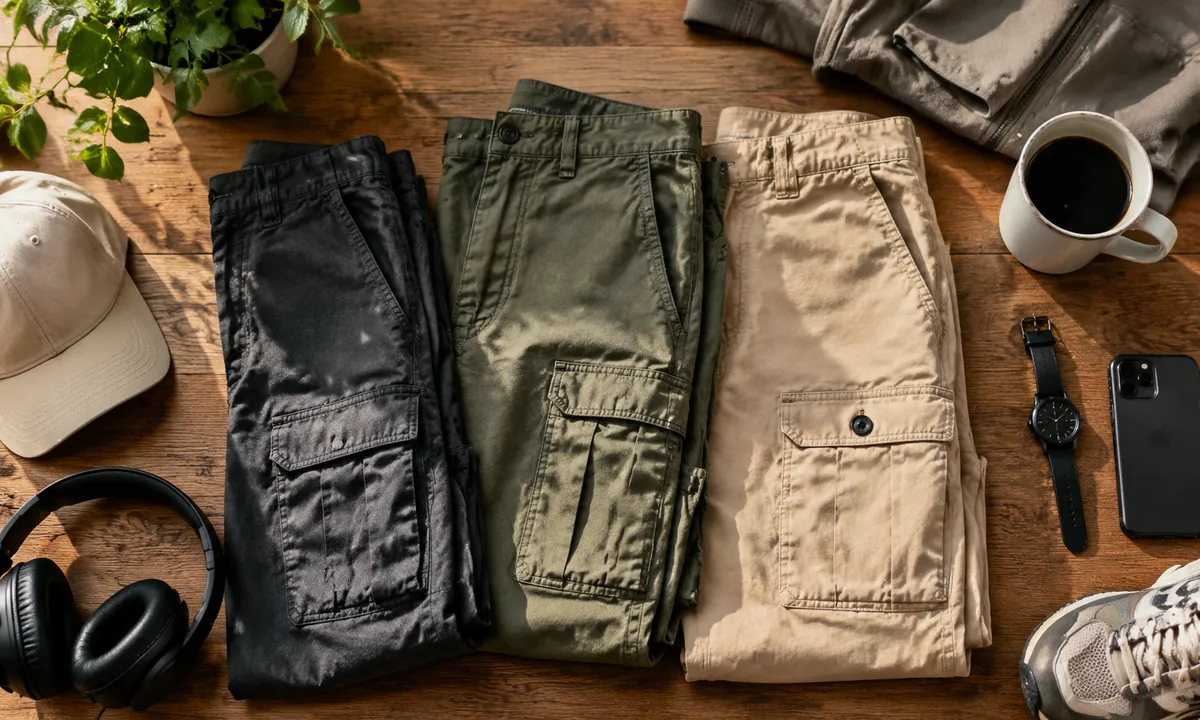
The experiment was simple. For seven days, no sweatpants. Cargo pants only, from waking up to going to bed. The same three pairs rotated: one slim-cut pair in olive, one wider-leg pair in khaki, one dark charcoal pair that could pass as chinos in low light. The sweatpants stayed folded on the shelf like a reminder of what was being given up.
Day One Feels Like a Small Betrayal
Sweatpants have a waistband that negotiates. It gives when you sit, breathes when you crouch, and never registers a meal. Cargo pants have a waistband that holds a position. The first morning felt like wearing an opinion: this is what you are doing today, this is how you are standing, this is the silhouette you are presenting to your refrigerator at 7 a.m.
That sounds like a complaint. It turned out to be something else.
By 10 a.m., there was a phone in the left thigh pocket, keys in the right cargo pocket, a pen clipped inside the smaller utility pocket on the left side, and a folded receipt tucked in the back. The front pockets stayed empty. For the first time in recent memory, a pair of pants was doing actual work: weight was distributed, nothing was cramming against anything else, and reaching down for the phone felt natural rather than a minor excavation.
What the Pockets Actually Changed
The pocket situation in most pants is a quiet indignity. Dress pants have shallow slots that barely hold a card. Jeans have the right front pocket depth, but the fit often means that sitting down turns the phone sideways and jams it against the thigh. Sweatpants, for all their comfort, offer soft pockets that swallow things and offer no structure: a phone shifts, earbuds tangle, small items disappear into the fabric.
Cargo pockets solve a different problem than most people give them credit for. The point is not volume. The average person is not carrying field equipment or tools for a job site. The point is separation. Phone in one place, always. Keys in another, always. A granola bar or a spare mask or a small notebook in the cargo pocket, which closes with a snap or a button and does not empty itself when you sit. By day three, reaching for things had become automatic in a way that never happens with sweatpants, where everything ends up in the same general pouch of fabric.
The Comfort Gap Is Real but Smaller Than Expected
Here is where an honest accounting gets complicated. Cargo pants, even good ones, are not as comfortable as sweatpants. That gap exists and it is not nothing. The first two days had a mild awareness of the fabric: a slight stiffness in the knee when sitting cross-legged, a reminder that the waistband was there when leaning back in a chair for an hour. That kind of wearing-in period is real.
But it compresses faster than expected. By day four, the olive pair had broken in enough that the fabric moved with the body rather than against it. A lot depends on construction: cheaper cargo pants use a stiff canvas that never softens much, while a cotton-nylon blend with a light stretch woven in gets comfortable quickly. The wide-leg khaki pair was the most comfortable of the three from the start, mostly because the extra room eliminated any friction at the knee or thigh. It wore more like a sweatpant than either of the slimmer options.
The charcoal pair, cut slim, was the hardest. Slim cargo pants compress the pocket utility that makes the whole category worthwhile. The thigh pockets bulge visually when loaded and the fabric pulls. A slim fit works on cargo pants only if the cargo pockets stay mostly empty, which defeats the purpose.
Moving Around in Them
Day five involved a longer walk, around four miles, and a hardware store trip that required crouching in an aisle to read the back of a box. Both were fine. The khaki pair handled the walk without any friction complaint, and the cargo pockets kept their contents in place without swinging or shifting in a way that disrupted the stride. Sweatpants are lighter and airier on a walk, and that is a real difference on a hot day, but in mild weather the cargo pants held their own.
Sitting for long stretches at a desk is where cargo pants show their one structural weakness more clearly. The thigh pocket, when loaded, can push up into the underside of the desk or create a pressure point against the chair arm. This is a problem of loaded pockets, not of the pants themselves, and it mostly disappears when the thigh pocket carries lighter or flatter items. A phone and a folded piece of paper sit fine. A phone, a charger, and a small notebook do not.
How They Read in Public
The aesthetic rehabilitation of cargo pants has gone further than the mockery years would have suggested possible. The olive pair drew no attention in a coffee shop, a bookstore, or a casual lunch spot. The wide-leg khaki pair, which reads more deliberately styled, got a compliment on day six from someone who asked where they were from. The charcoal pair passed as standard chinos to anyone not looking closely.
The key variable is the pocket hardware. Cargo pants with heavy plastic buckles and excessivestitching still read as utilitarian in a way that can feel out of place in a restaurant. Cargo pants with clean button closures or simple snap pockets read as regular trousers with extra room. The difference between looking like you are about to go hiking and looking like you just have good pants comes down almost entirely to how the pockets are finished.
Sweatpants, for all their dominance in daily life, do not travel into most social spaces without a comment, a glance, or a moment of self-consciousness. Cargo pants, in the right cut, walk into almost any casual environment without announcing themselves.
The Posture Effect Nobody Mentions
This one is harder to quantify but hard to ignore after a week. Wearing a structured garment with a real waistband changes how a person carries themselves. Sweatpants allow a slump that cargo pants simply do not accommodate as easily. The structure is mild, not restrictive, but it is present. Standing in cargo pants feels slightly more upright, more deliberate, without any real effort.
Whether that matters depends on what a person is doing. For a day spent on thecouch, the sweatpant slump is the entire point. For a day that moves through several different environments, that gentle uprightness turns out to be a net positive: less adjustment when walking into a store, less awareness of how you look when you stand up from a chair in public.
What Sweatpants Do That Cargo Pants Cannot
After seven days, the sweatpants went back on and the relief was immediate and specific. The waistband released. The fabric draped rather than held. The warmth was different, softer, more even across the leg. For the first hour of a morning, when the body is still deciding what it is doing, sweatpants remain the most comfortable thing a person can put on their lower half while still being dressed.
Cargo pants do not replicate that. They offer a different contract: more structure, more utility, more versatility in where you can go in them. The trade is real. Anyone who claims cargo pants are just as comfortable as sweatpants is either wearing a very forgiving cut or is not paying attention to what their body is doing.
The week made one thing clear: the choice between them is not really a question of which is better. It is a question of what a given day requires. A day at home, low movement, bad weather outside: the sweatpants win easily. A day that starts at home and moves into the world, involves carrying things, and ends somewhere other than the couch: the cargo pants are the better tool for the full range of what that day asks.
By the end of day seven, the olive pair was sitting on top of the pile where the sweatpants used to be. That reshuffle says most of what needs saying.