


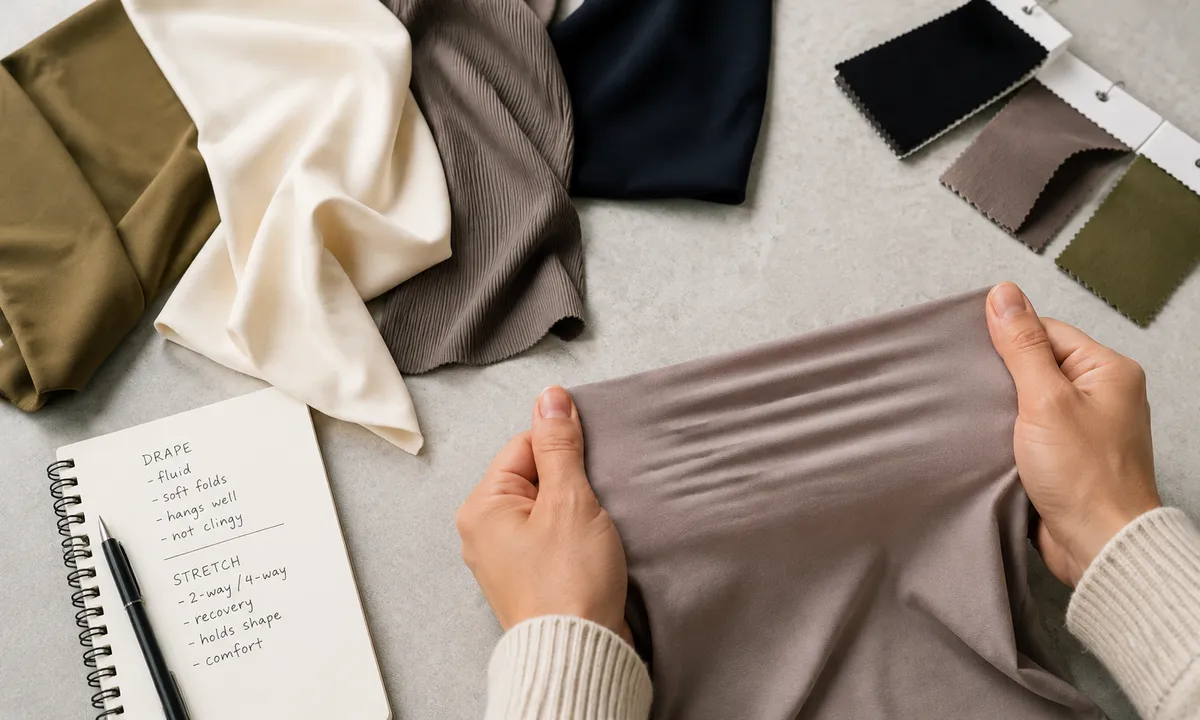
Fabric testing is one of those skills that takes maybe three minutes to learn and saves years of regret. Most people skip it entirely, which explains why closets everywhere contain perfectly good-looking clothes that hang wrong, bag at the knees after one wear, or go limp the first time they meet humidity.
Drape and stretch are the two properties that determine whether a garment actually works on a moving body. They are not the same thing, they test differently, and both need attention before anything gets carried to the register.
What Drape Actually Means
Drape is the way fabric falls under its own weight. A fabric with good drape flows, pools, follows the body’s contours without fighting them. A fabric with poor drape stands away from the body, holds a stiff shape, or collapses in flat panels instead of curves. Neither is universally bad. Denim is supposed to hold its shape. A silk blouse is supposed to fall cleanly. The question is whether the fabric’s drape matches the garment’s design intent, and whether that intent matches the wearer’s body and purpose.
A structured blazer cut from a fluid crepe will look shapeless. A pleated midi skirt cut from stiff poplin will stick out at the hips like a paper bag. These are not fit problems. They are drape problems, and no alteration fixes them.
The Drape Test: How to Do It in the Store
Pull a section of fabric, at least a forearm’s length, off the hanger or fold and hold it loosely in one hand. Let it fall. Watch what it does.
Good drape creates rounded folds, like liquid. The fabric relaxes downward rather than jutting out. If the edge of the hanging fabric curves gently inward, the weight is doing its job. If the fabric sticks out horizontally, or holds a crease from the fold it was sitting in for three weeks, that tells the whole story.
Then drape it over the back of a hand, or over a shoulder if there is a fitting room nearby. Any fabric that springs back up or holds a tent shape over the hand is going to do the same thing over a shoulder blade, a hip, a knee. That springiness reads as stiffness on the body.
For skirts and trousers especially, hold the fabric between both hands and raise one hand slightly higher than the other, the way a garment would hang unevenly across a hip. Stiff fabric bunches or pulls in a flat horizontal line. Fabric with real drape shifts smoothly and adjusts to the angle.
Weight matters here. Heavier fabrics generally drape better than lighter ones made of the same material, which is why cheap polyester is so unforgiving while a heavier matte polyester from a quality line can behave almost like crepe. Threadcount, weave tightness, and fiber blend all affect how much weight is packed into the fabric. Hold two blouses of apparently similar material and compare the weight directly. The heavier one almost always drapes better.
Stretch: More Than Just How Far It Pulls
Stretch is more nuanced than drape, because there are several kinds. Two-way stretch means the fabric extends along one axis, typically the width. Four-way stretch, sometimes called bi-directional, extends in both directions: width and length. The distinction matters enormously for athletic wear, fitted dresses, and anything meant to move with the body rather than restrict it.
A basic cotton jersey T-shirt has two-way stretch. It gives across the chest. It does not give from shoulder to hem, which is why reaching up sometimes pulls the whole shirt out of pants. A well-made legging has four-way stretch, meaning a deep squat does not turn them sheer across the seat and a long stride does not haul the waistband down.
To test for direction, pull the fabric gently in two directions: horizontally across the grain, then vertically along the length. Try to notice not just whether it stretches but how far and how evenly. Uneven resistance usually means the stretch is built into the weave in only one direction, or that the elastane content is low and concentrated in the threading rather than distributed through the fiber blend.
Recovery: The Test Most People Miss
Stretch without recovery is just bagging waiting to happen.
Recovery is the fabric’s ability to return to its original dimensions after being stretched. It is what keeps the knees of trousers from going baggy by noon and what keeps a fitted dress fitted after a few hours of sitting. A fabric can feel wonderfully stretchy in the store and still lose its shape completely within a season if the recovery is poor.
The test is quick: stretch a section of the fabric firmly for about ten seconds, then release it and watch how quickly and completely it snaps back. Fabrics with high elastane content and tight knit construction return almost instantly, with no visible looseness in the grain. Fabrics with weak recovery will show a slight but visible relaxation after the stretch, a small waviness or looseness in the weave that was not there before pulling.
Cotton-spandex blends at the lower end of the spandex range, say two or three percent, often have decent stretch but mediocre recovery. A blend with eight to ten percent elastane, knit tightly, recovers fast and holds its shape through long wear. Those percentages are usually on the label. When they are not, the snap-back test does the job.
Perform this test on a seam area if possible, not just the flat body of the fabric. Seams add stress points, and the recovery at the seam often differs from the recovery in the open panel. The seat seam of a pair of trousers takes more sustained tension than almost any other part of the garment, and a weak-recovery fabric at that seam will show wear and distortion faster than anywhere else.
Reading Fiber Content as a First Filter
Before touching a garment at all, the care label is worth reading. Fiber content does not guarantee anything, but it narrows the field quickly.
Viscose and Tencel (lyocell) drape beautifully, nearly as well as silk, and cost a fraction of the price. They are a reliable signal that a blouse or dress was designed with flow in mind. Linen and stiff cotton broadcloth have almost no natural drape and are at their best in structured silhouettes. Polyester spans the entire range depending on weave and weight, which is why the hand test matters more for synthetic blends than for naturals.
Wool crepe and ponte are natural stretchers with good recovery, even without added elastane. Double-knit constructions in any fiber tend to hold their shape better than single-knit, which is often why a ponte blazer outlasts a jersey one through a full workweek without going soft.
Modal is worth paying attention to. It drapes like viscose but recovers better after washing, which matters for anything that goes in the machine regularly. A high-modal T-shirt is more likely to stay fitted through six months of weekly washing than a straight viscose one, even if they feel identical in the store.
Where Drape and Stretch Intersect: Fitted Knits
Fitted knit garments, jersey dresses, ribbed tops, wrap sweaters, ask both properties to work at once. The fabric has to stretch enough to go on and move freely, but it also has to have enough weight and recovery to hang cleanly rather than clinging in unflattering directions.
A thin, high-stretch jersey with poor recovery does the worst of both: it pulls across the body where it is under tension, sags at the hem where it is not, and the whole garment slowly migrates upward over the course of a day. A heavier matte jersey with moderate stretch and strong recovery falls straight, moves with the body, and returns to shape between wears.
In the store, try the drape test and the snap-back test on the same garment. If the fabric passes both, it will almost certainly behave well over time. If it passes the stretch test but fails the drape test, it might be comfortable but it will look wrong. If it drapes beautifully but has almost no stretch, check that the garment is designed to be worn that way: plenty of beautiful dresses are cut on the bias specifically because the design accounts for zero stretch in the fabric.
What Finishing and Lining Do to Both Properties
A lining changes everything. A fluid chiffon skirt lined with stiff polyester taffeta loses most of its drape because the lining is holding the outer fabric away from the natural fall it would otherwise have. Good lining fabrics are slightly lighter than the shell fabric and match or improve its drape rather than fighting it. Silk crepe de chine lining is expensive but functionally correct for most fluid shells. A decent polyester lining cut on the same grain as the outer fabric usually works well. A lining that was clearly added as an afterthought often ruins garments that would otherwise be excellent.
Fabric finishes also matter. Starch, resincoatings, and certain anti-wrinkle treatments stiffen fabric and artificially improve its appearance on the rack while hiding its true drape. A lightly starched cotton shirt can feel stiff and structured in the store and go completely limp after the first wash. Running a section of fabric between two fingers and feeling for a papery resistance, rather than the softness of the unfinished fiber, is a reasonable way to spot heavy finishing. Fabrics with a lot of surface coating also tend to feel slightly cooler and slicker than unfinished versions of the same fiber.
When in doubt, dampen a small, hidden corner of the fabric, the inner seam allowance if visible, or the underside of a collar. Finished fabric often goes soft immediately when wet, which is a preview of what the first wash brings. That thirty-second test has prevented more disappointments than any amount of careful inspection of the dry fabric alone.