


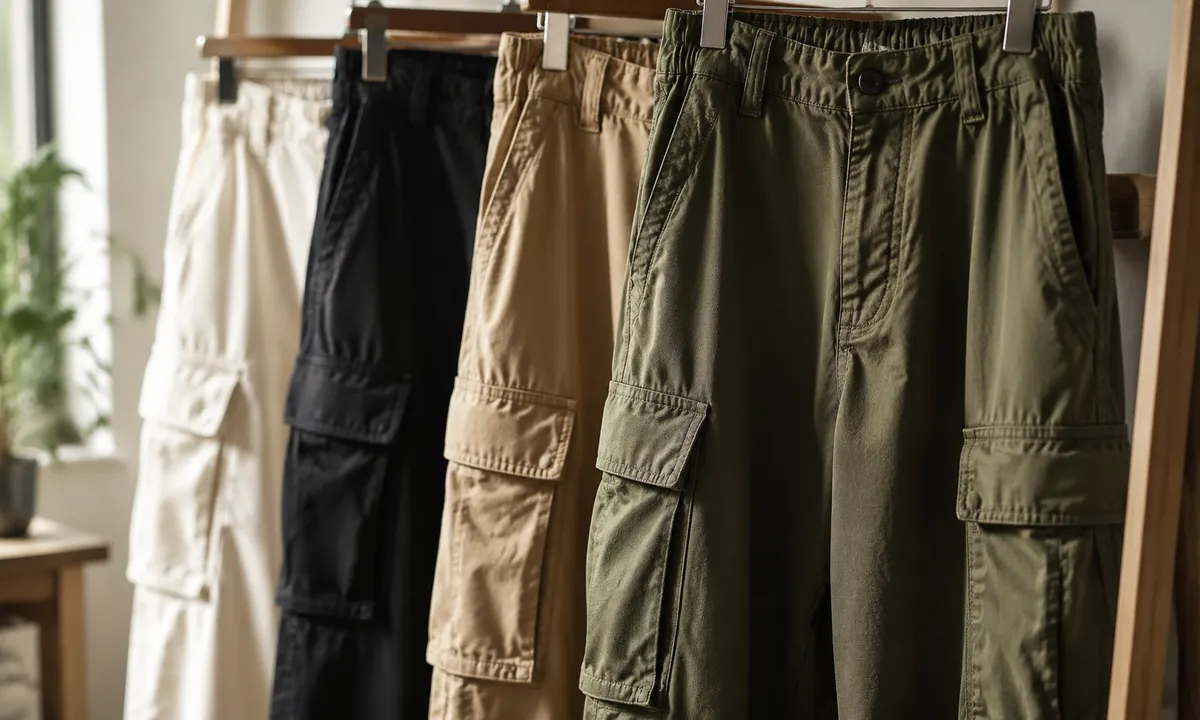
Cargo pants with a baggy cut occupy a genuinely awkward middle ground in most people’s wardrobes. They’re bought for comfort and worn with low expectations, then abandoned to the back of the closet because every combination tried with them looked, somehow, like too much. The pockets catch the eye. The volume catches the eye. The result is an outfit that seems to announce itself before the person wearing it even walks into the room.
The reason most baggy cargo outfits read as chaotic has nothing to do with the pants themselves and everything to do with proportion. When the garment is already carrying a lot of visual weight, everything else needs to pull back. The instinct to match volume with volume, a wide pant with an oversized hoodie or a boxy fleece, turns a relaxed silhouette into something that reads as an accident.
The Proportion Rule That Actually Holds
Baggy cargo pants read cleaner when the top half of the outfit stays narrow. A fitted ribbed tank, a slim-cut long sleeve, a close-to-the-body crewneck: any of these give the eye a place to rest before the width of the pants takes over. The contrast is what creates the impression of intention. Without it, the outfit is all the same volume, from collar to cuff, and nothing holds the shape together.
This works across seasons. In warmer months a plain fitted tee tucked at the front, not fully tucked, just clipped in at one side, gives the silhouette a waist without any structural garment doing the work. In fall or winter, a slim turtleneck under a straight-cut coat keeps the top half sleek while the pants do whatever they want below.
The exception that proves the rule: an oversized button-up shirt, left open and worn as a layer over a fitted inner, can work because the open shirt functions more like a frame than a mass. It doesn’t add bulk the way a closed fleece does. The distinction matters.
How to Handle the Pockets
The cargo pockets are the defining detail. Ignoring them stylistically, treating them as a neutral design element, tends to backfire because they’re never neutral. They’re large, they sit on the thigh, and depending on what’s stuffed into them, they can throw the entire line of the leg off-balance.
Leaving the pockets empty keeps them flat against the leg and lets the pant do its job as a silhouette piece rather than a utility garment. This sounds obvious and yet it’s what most people skip. A phone in the right cargo pocket, keys in the left, and suddenly the thighs have different widths and the pants look like they’re working hard. Keep heavy objects in a bag or a back pocket, not in the cargo flap.
As for the pockets themselves as a visual element, darker washes tend to flatten them. Olive, charcoal, black, and dark navy all minimize the pocket’s dimensional quality because the shadow contrast is lower. Light-wash cotton or pale khaki cargos make every seam and flap pop, which raises the volume of the detail considerably. That’s not automatically wrong, but it requires even more restraint everywhere else in the outfit.
The Length and the Shoe
Baggy pants that stack heavily at the ankle tend to look unfinished unless the stack is genuinely clean: same fabric, smooth fold, not a twisted pile of excess material. The more reliable move with a wide-cut cargo is a hem that hits at or just above the ankle, which keeps the line from getting muddy at the bottom. If the pants are too long, a single clean roll of about an inch and a half brings the hem up without looking too deliberate.
Shoes do a lot of work here. A chunky trainer or a low-profile sneaker in a neutral color, white, black, gum sole brown, grounds the pant leg without adding more visual mass at the foot. What tends to go wrong is a thin, sleek shoe under a very wide leg: the proportions pinch at the ankle and the whole silhouette looks top-heavy. Some width at the shoe actually helps the leg taper correctly by giving it something solid to land on.
Boots work well for the same reason, particularly a lug-sole boot with a slightly wider toe box. Combat boots in black or tan with a black cargo pant remain one of the more foolproof combinations available. The visual weight at the bottom anchors the volume of the pant instead of fighting it.
Color and Texture as a Stabilizer
An outfit built around baggy cargos is already doing a lot structurally, so the color palette should stay simple. Two or three colors at most. A tonal outfit, everything in the same family of warm neutrals or cool grays, looks considered even when the individual pieces are casual. The restraint in color telegraphs intention more clearly than any specific item choice.
Olive greencargos are the most common version sold, and they also carry the most visual history: they read military-adjacent by default, which can be a coherent aesthetic or an unintended vibe depending on what’s paired with them. Neutralizing that reference is easy. A white or cream top, a simple tote, and clean sneakers shift olivecargos firmly into relaxed casual. Doubling down on the utility coding, with a workwear jacket or military surplus pieces, makes it an explicit aesthetic choice rather than a default.
Texture mixing can add interest without adding complexity. A cotton cargo pant paired with a knit top has enough surface variation to feel layered, while the silhouettes themselves stay simple. Adding a third texture, say a nylon windbreaker, works when the shapes remain clean. Adding a fourth texture in a wide-leg outfit is usually where things start to feel visually cluttered.
What Makes the Outfit Feel Pulled Together
Fit at the waist is what separates a well-styled baggy cargo outfit from a shapeless one. The pants should sit at a specific point on the body, whether that’s at the natural waist, the hip, or somewhere in between, and they should stay there. Cargos that drift low throughout the day, slowly revealing the waistband of whatever is underneath, collapse the intentionality of everything else. A belt is underused in baggy-pants styling. Even a simple woven belt or a plain leather one in a matching tone visually anchors the pant to the body and gives the outfit a clear waistline to organize around.
Accessories stay minimal for the same reason color does. One bag, one pair of earrings, a watch or a bracelet. Piling on jewelry, a bucket hat, a shoulder bag, and layered necklaces when the pants are already a statement turns the whole thing into a competition for attention. The cargo pants will win that competition and nothing else will read.
The One Combination Worth Committing To
Charcoal or dark olive baggy cargos, hem sitting just above the ankle, a fitted white or light gray long sleeve, and a low-profile white sneaker. Belt in black or tan. No bag with competing hardware. No logo-heavy pieces fighting for the same space. This specific combination works in almost any casual context because every decision in it is subtractive: the pants carry the visual weight and everything else declines to compete.
The person who wears this combination and adjusts it slightly, swapping the sneaker for a boot in winter, the long sleeve for a tank in summer, is working from a silhouette logic rather than copying a trend. That’s the real distinction between an outfit that looks messy and one that looks intentional: one is a pile of things put on, and the other is a set of relationships between things that someone actually thought about. With a wide, pocket-heavy pant, those relationships have to be deliberate. There’s no accidental version that works.