


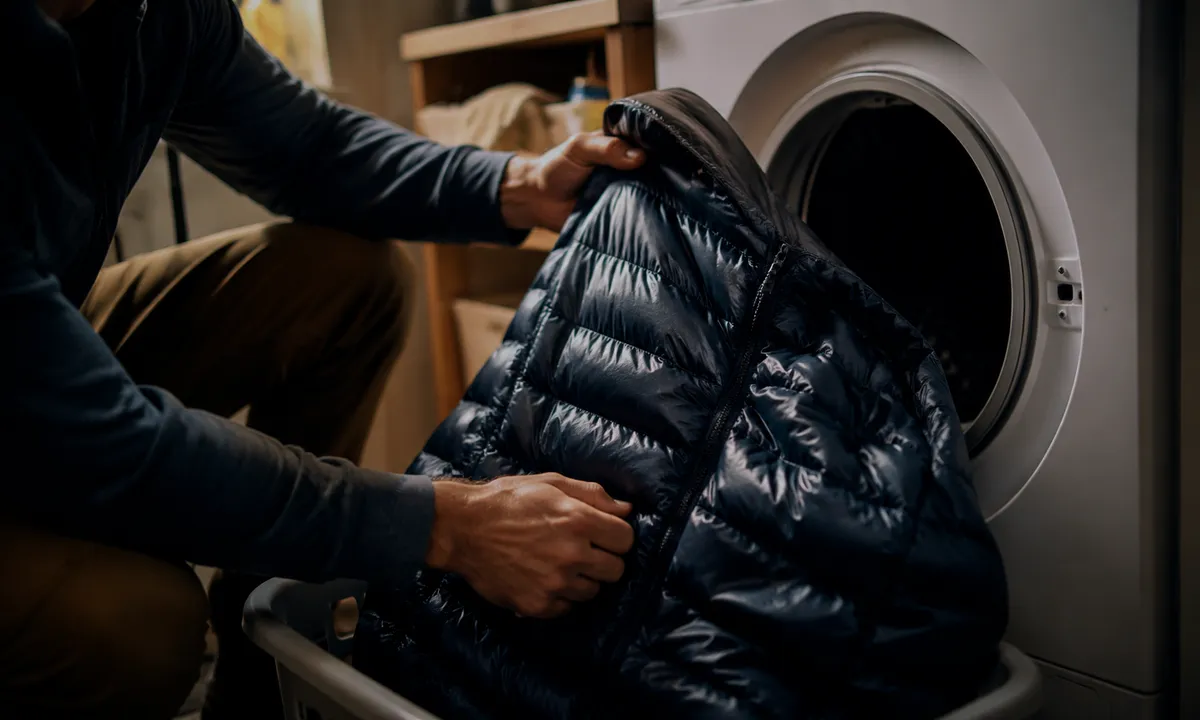
Down insulation works on a simple principle: it traps air. The clusters of down, called plumes, interlock and puff outward to create millions of tiny pockets of warm air against the body. When a jacket goes flat, those clusters have matted together into a wet, compressed mass and those pockets have collapsed. The warmth problem is entirely a loft problem.
Most flat down jackets are not ruined. They are just stuck.
Why Down Goes Flat in the First Place
Moisture is the main culprit. Down plumes are hygroscopic, meaning they absorb ambient moisture from sweat, rain, and even humid storage air. Once wet, the filaments within each plume clump together and the structure that was holding air open collapses inward. A jacket stuffed into a compression sack for six months in a closet with any humidity will come out noticeably less lofty than it went in. That is not unusual. That is just what down does when it sits compressed and slightly damp.
A secondary cause is body oils and detergent residue. The natural oils from skin migrate into the down over time and coat the plume filaments, making them stick together rather than spring apart. Detergent that did not fully rinse out does the same thing, and it will also attract more grime. A jacket that smells musty after washing was almost certainly under-rinsed.
Both problems are fixable at home with a front-loading washer, a dryer, and a little patience.
The Dryer Method: Heat and Physical Agitation
For a jacket that is flat from storage compression or humidity, skipping the wash and going straight to the dryer is often enough. Set the dryer to low heat, put the jacket in, and add two or three clean tennis balls or dryer balls. The balls break up the matted clumps mechanically as the jacket tumbles, and the gentle heat helps the plumes dry and re-expand. Run it for 20 minutes, pull the jacket out, and break apart any remaining clumps by hand through the shell. Reload and run another 20 minutes. Repeat until the jacket looks full again.
This takes longer than most people expect. A seriously compressed jacket can need 60 to 90 minutes of total dryer time, spread across several cycles with manual clump-breaking in between. The instinct is to run it straight through on high heat to speed things up. Resist that. High heat damages the shell fabric and can melt the lightweight ripstop weaves common in modern down jackets. Low and slow is the actual method, not a cautious alternative to it.
When to Wash Before Drying
If the jacket is flat and has visible soiling, a greasy feel to the inner lining, or a sour smell that persists after drying, it needs a proper wash first. Washing lifts the oils and residue that are binding the plumes together. A dryer session alone will not solve an oil problem; it will just warm up compressed, oily down.
Use a front-loading washing machine. Top-loaders with a central agitator are too rough on down fill and baffling and can break the internalstitching that keeps the fill distributed. A front-loader tumbles the jacket gently. If only a top-loader is available, use the delicate cycle and check that the agitator does not force the jacket into contorted positions during the spin.
Use a down-specific wash, such as Nikwax Down Wash Direct or Granger’s Down Wash, rather than standard laundry detergent. The difference matters here. Regular detergent strips the natural oils from the down too aggressively and leaves more residue behind, both of which degrade loft. Down wash is formulated to clean without those effects. Use the amount specified on the bottle, which is usually less than people expect.
Wash on cold or warm, gentle cycle. Then run an extra rinse cycle. Then run one more. The goal is getting every trace of soap out of the fill, and it almost always takes more rinses than the machine’s standard program delivers.
Drying a Washed Jacket Properly
After washing, the jacket will look spectacularly bad: flat, soaked, heavy, with obvious lumps of wet down visible through the shell. This is normal. The fill has absorbed a lot of water and the plumes are matted together. The drying process is what reverses it.
Transfer the jacket carefully to a dryer. Low heat, dryer balls or tennis balls, same as above. The first 20 minutes will seem to accomplish almost nothing; the jacket comes out damp and still visibly flat. Keep going. As the moisture leaves the fill, the plumes begin to separate and expand. Around the 45-minute mark, the jacket will start to look like itself again. Full loft on a thoroughly washed jacket can take anywhere from 90 minutes to two and a half hours of low-heat drying, depending on the fill weight and shell thickness.
The jacket must be completely dry before it goes into storage or regular use. Down that is stored even slightly damp will mildew, and mildew damage to down is not recoverable through washing. The test is to feel every baffle section individually: squeeze them gently and make sure they feel uniformly lofty with no dense, damp spots at the corners or seams. Those corners are where moisture hides longest.
Spot-Testing the DWR Finish
Many down jackets have a durable water-repellent (DWR) finish on the outer shell. This finish degrades with wear and washing, and when it fails, the outer fabric begins to absorb moisture instead of shedding it, which leads to faster loft loss in wet conditions. It is worth checking this after any wash cycle.
Sprinkle a few drops of water on the shell fabric. If they bead up and roll off, the DWR is still working. If they soak in and darken the fabric, the finish needs refreshing. A DWR-restoring spray, applied after drying and then heat-activated with a tumble in a warm dryer for about 20 minutes, will bring back water resistance. This is a separate treatment from the down wash and does not need to happen every cycle, but it is worth doing whenever the beading test fails.
Long-Term Storage Habits That Prevent Future Flatness
Compression is what kills down over time. A jacket stored for months in its stuff sack, or shoved into a tote bag at the back of a shelf, will have its plumes locked in a compressed position long enough that they partially lose their ability to spring back. High-quality down recovers from this, but it degrades gradually with every storage season spent under pressure.
Store down jackets loosely, either hanging or folded lightly inside a large mesh bag or cotton storage bag. The goal is zero sustained compression. Many jackets come with a large mesh bag for exactly this purpose, and it is not just packaging: it is the intended storage method.
Storing the jacket clean also matters more than most people act on. Oils and grime that sit in the fill for an entire off-season have months to bind the plumes together. Washing the jacket before long-term storage rather than after takes it out the following autumn in noticeably better condition than washing it the spring before did.
When the Jacket Needs Professional Re-Lofting or Fill Replacement
A jacket that has been through the full wash-and-dry process two or three times and still will not loft properly has a different problem. The down fill itself may have degraded, meaning the plumes have broken down into smaller fragments, called down fiber or pod fiber, that cannot interlock and trap air the way intact plumes do. This happens with age and with repeated rough washing, and it cannot be reversed.
At that point, there are two real options. A handful of outdoor gear repair services and specialty shops, including some associated with brands like Patagonia and REI, offer down cleaning and re-lofting services that involve professional industrial cleaning equipment capable of restoring fill that home methods cannot. For jackets with significant sentimental or monetary value, this is worth pursuing. The second option is adding new down fill: a down jacket repair service can open baffles and inject additional fill to restore warmth, which extends the jacket’s useful life considerably without replacing the whole garment.
A jacket that lofts unevenly, with certain baffles noticeably thinner than others, usually has a fill migration problem rather than a general degradation problem. The down has shifted through small holes in the baffling or seams and collected in one area. This is a sewing repair, and fixing it early prevents the redistribution from getting worse. Running a finger along the seams of a flat-feeling baffle will often locate the gap where fill has escaped, and a small stitch by hand or by a tailor is enough to stop the migration.
That specific repair, a three-minute job with a needle and thread on a seam the width of a fingernail, is the difference between a jacket that keeps its shape for another decade and one that develops a permanently cold spot across the left shoulder every February.