


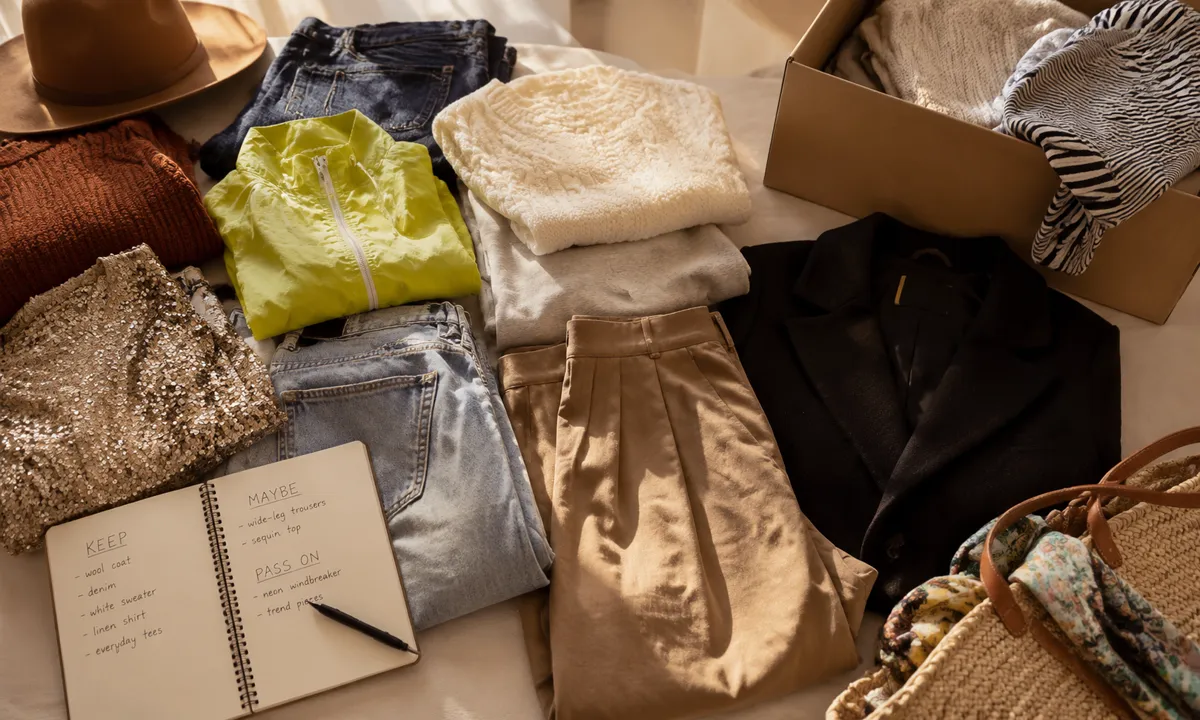
Every closet has a stratum of regret. It sits somewhere between the reliable wool coat and the impulse buys that never made it past a second wearing: a neon windbreaker bought in a fever of optimism, a pair of wide-leg trousers that arrived six months before anyone could pull them off, a sequined top purchased because the moment demanded it and nothing else. The question is not whether that stratum exists. The question is what to do about it.
Editing a closet is not the same as purging it. Purging is satisfying but blunt. Editing is surgical: it requires distinguishing between a garment that was never right and one that is simply waiting for its moment to pass. Fads and keepers look almost identical when they are new. The work is learning to tell them apart before spending money, and then being ruthless about the ones that slipped through anyway.
What a Fad Actually Looks Like Up Close
A fad is not just a trend. Plenty of trends become classics: the slim chino, the white sneaker, the trench coat all went through a moment of peak trend and came out the other side as reliable, low-stakes dressing. A fad is a trend with a short half-life and a strong signature. The stronger the signature, the faster it dates.
Logos that cover the entire surface of a bag. Extremely specific color combinations (that particular shade of millennial pink paired with camel). Sleeves so voluminous they caught on doorframes. These are fads because the detail that made them exciting is also the detail that makes them look ridiculous in three years. The eye that found them fresh is the same eye that will find them exhausting.
A useful heuristic: if the item requires a specific cultural moment to read correctly, it will not survive that moment. Graphic tees that reference a specific meme, shoes that only made sense during a particular aesthetic cycle on social media, anything that was essentially a costume for a particular online identity. These are not wardrobes. They are documentation.
The Keeper Test Is About Proportions, Not Timelessness
The word “timeless” gets thrown around as if it means something, but in practice it mostly describes things that are boring. A well-cut navy blazer is timeless. So is a camel cashmere turtleneck. Fine. But keepers are not always safe. Some of the best pieces in a wardrobe are a little strange, a little specific to a person’s actual taste rather than a default idea of good dressing.
The real keeper test is about proportions: how much of the item’s appeal comes from the shape, the material, or the color, versus how much comes from an extremely specific surface detail. A blazer with unusually wide lapels is a statement, but it is a statement about structure, which cycles back. A blazer covered in a pattern that was visible on every Instagram post in a particular three-month window is a different problem entirely.
Material is usually on the side of longevity. Heavy cotton, real wool, leather that will age into itself, silk that drapes rather than clings: these tend to reward keeping because they look better, or at least more interesting, over time. The synthetic that looks great on a hanger and pills after four wears is telling you something. It was made for a short relationship.
The Cost-Per-Wear Calculation Has a Ceiling
Cost per wear is a legitimate framework but it invites a particular kind of rationalization. A $600 coat worn 200 times over ten years costs $3 per wear. True. But the reasoning gets applied backward: “I spent a lot on this, therefore I will find a way to keep wearing it.” That is loyalty to a purchase, not to an actual wardrobe.
The harder question is whether the item is getting worn at all, or whether it is being kept because letting it go would mean admitting a mistake. A blazer that sits untouched for two full years is not a keeper waiting for the right occasion. It is a fad with good material, which is the most expensive kind of fad.
A reasonable edit cycle: anything that has not been worn in 18 months gets pulled from the main closet and put somewhere less convenient. If it does not get reached for in the next six months, it goes. The inconvenience is the point. Distance clarifies whether the reluctance to let go is genuine attachment or just habit and guilt.
How Fads Get In (and Why the Usual Advice Misses It)
The standard advice is to avoid fast fashion and shop intentionally. This is correct but incomplete, because plenty of fads arrive through expensive channels. A $400 shirt in a shape that reads as extremely of-this-moment is still a fad. The markup does not insulate against trend volatility. Sometimes the opposite: high-end fashion cycles faster than the midrange because it moves in tighter circles and needs to produce novelty on a shorter schedule.
Fads get in because shopping is emotional and context-dependent. A piece that looks perfect in a store with the right lighting and a specific mood playing over the speakers will look different at 7 a.m. on a Tuesday in a real bathroom. Stores are stages. The item is being presented in its best possible performance, and the buyer is often at a heightened state of receptivity, which is what the environment is designed to produce.
The most reliable filter is time. Not the standard “sleep on it” advice, which is usually stretched to 24 hours, but longer: a week, ideally two. The items that survive two weeks of actual consideration are ones where the desire is not purely situational. Most fads do not survive two weeks of calm reflection. They depend on the mood of the moment.
Sorting Through What Is Already There
The editing process works better in batches by category than as a whole-closet overhaul. Doing the entire closet at once creates decision fatigue fast, and the last 30 percent gets evaluated badly. Better to spend 45 minutes on outerwear, then come back next weekend for trousers, then the week after for shirts and tops.
When pulling items out for consideration, the useful questions are specific. Does this fit the body as it actually is, or as it was three years ago? Does it require a specific other item to work, and is that item still in the rotation? Would this be bought today, at the same price, in a calm state of mind?
The last question does the most work. A lot of the closet stratum survives on inertia, not affection. Asking whether the purchase would happen today, as a deliberate choice, separates the things genuinely wanted from the things merely accumulated.
Sentimental attachment is a real category and deserves its own shelf. Clothes that carry genuine memory, a jacket worn at a particular event, a sweater that belonged to someone, do not need to earn their keep by regular rotation. They are different objects. The problem is when sentiment gets extended to things that are not actually sentimental, just expensive or vaguely familiar.
What Gets Kept and Why the Line Moves
The line between a fad and a keeper is not fixed. Some items that read as trend-specific at purchase age into something more personal. A loud floral blazer bought in a trend moment might, five years later, look individual rather than dated, worn with enough confidence and with other things that ground it. This is the opposite trajectory from the usual: instead of aging badly, it aged into a style.
That trajectory is genuinely hard to predict in advance, which is one reason the two-week waiting rule is more useful than trying to predict trend longevity. The question is not “will this be in style in five years” but “will I still want to wear this, and will it still be mine.” Those are answerable questions.
The keepers, after a proper edit, tend to share a few qualities. They fit without negotiation, meaning no specific undergarments required, no posture adjustments, no hoping the lighting will be good. They work with at least three other things already owned. And they do not require explanation: someone wearing a keeper is just dressed, not making a case for a choice.
The Sequined Top and What to Do With It
Back to that sequined top. Bought for a specific occasion, worn once, now occupying prime real estate in the closet on the basis of a good memory and the fact that it was not cheap. It has been passed over 40 times in the last year without a second thought.
The edit is clear. The memory is good. The top can go.
What replaces it, if anything, is a question about actual life: what occasions actually come up, what already exists for them, what genuine gap there is. Most closets do not have gaps. They have crowding in some areas and real shortfalls in others, usually the everyday rotation, the things that need to hold up to Tuesday and Friday and the weather in between. A rigorous edit almost always reveals that the fads took up space that was quietly needed for something less exciting and far more useful.