


Somewhere between the third unworn blazer and the fourth pair of trousers that almost fit, the pattern becomes impossible to ignore. The clothes are not bad. The colour is right, the fabric is decent, the price was reasonable. But nothing quite works, and the pile of almost-right purchases keeps growing anyway.
Body proportions are the piece of the puzzle that most style advice skips, because it is harder to sell than a colour palette and less photogenic than a capsule wardrobe flat lay. Knowing your proportions means understanding the specific ratios of your body: where your natural waist sits relative to your full height, how long your torso is compared to your legs, how your shoulder width relates to your hip width, and whether your limbs run long or short against your trunk. These are not aesthetic judgements. They are measurements, and they change the way every single garment lands on a body.
Once you know them, shopping changes completely.
What Proportion Actually Means in Practice
Proportion in clothing is about the relationship between a garment’s lines and the body wearing it. A wide-leg trouser that looks effortlessly relaxed on a person with a long torso and shorter legs can make someone with the opposite ratio look swamped from the waist down. A cropped jacket flatters a long-legged, short-torsoed frame by visually extending the leg line. On a long-torsoed person, that same jacket shortens an already-short leg. The jacket has not changed. The body has not changed. The proportion has.
The key measurements to know are: your total height, your high-hip to floor measurement (taken from roughly where your waistband sits to the floor), your shoulder width across the back, and where your natural waist falls as a percentage of your full height. Most people discover that their mental image of their own proportions is slightly off. Someone who thinks of themselves as short-legged might actually have a standard leg-to-torso ratio but an unusually long rise, which is a different fit problem with different solutions. Someone convinced their shoulders are narrow might find the measurement is average but their waist is wide, which creates the same visual effect for a completely different reason.
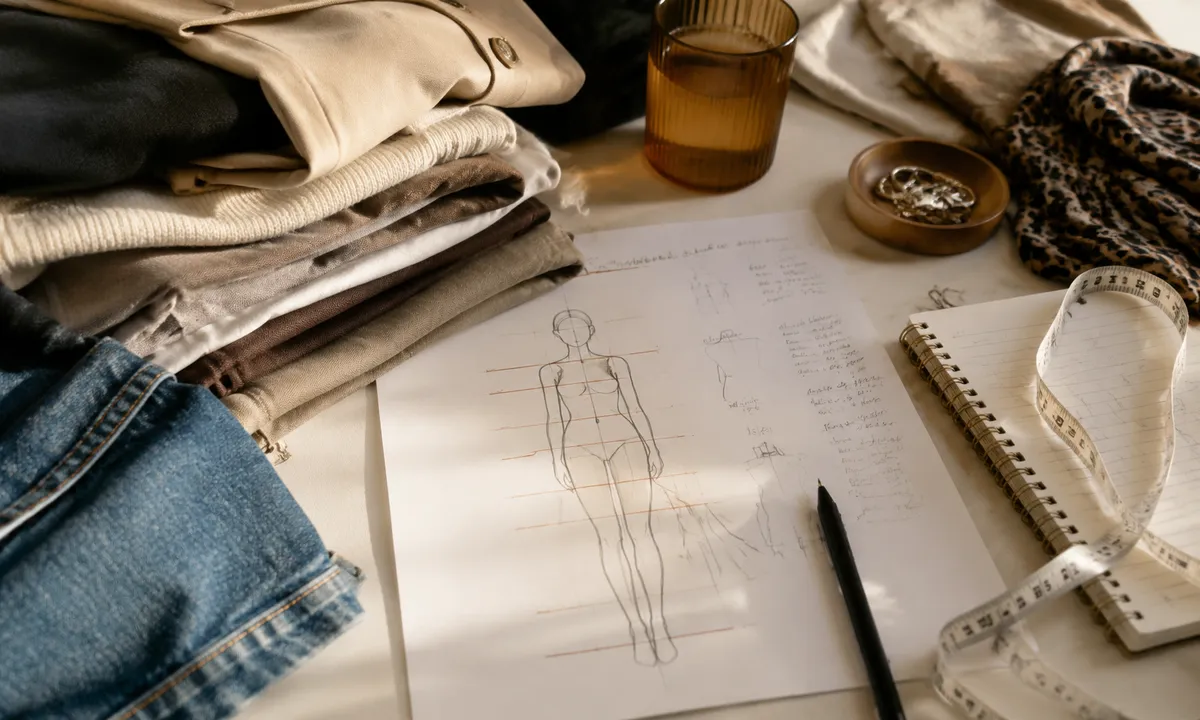
Taking the measurements with a soft tape and writing them down is the whole first step. Ten minutes, no cost.
The Shopping Habit These Numbers Interrupt
Impulse shopping has a specific texture. It is the dress spotted on a rail that looks better in the shop light than it ever will at home. The sale piece bought because the discount makes hesitation feel like waste. The item purchased after seeing it on someone else and assuming the effect will transfer. What all three have in common is that the body doing the buying is treated as a neutral variable, something clothes simply go onto. Proportions do not enter the calculation at all.
The moment a person knows their specific measurements, the calculation shifts. A midi skirt with a dropped hem that hits at the widest part of the calf is not a neutral option anymore. It is a specific choice with a predictable outcome for someone whose calves are their widest point. A shirt with a boxy cut and a hemline that falls at mid-hip is known to shorten the leg line visually. If you have a short leg-to-torso ratio, you can still buy it, but you know exactly what you are working with, and you know it will need to be tucked. The impulsive pick-it-up-and-buy-it-without-trying-it move becomes much harder to justify when you already know the answer.
This is where the impulse actually breaks. Not in willpower. In information.
Long Torso, Short Torso, and Why It Changes Everything
The torso-to-leg ratio is the proportion that affects the widest range of clothing decisions, and it is also the one most people have never consciously measured. A long-torsoed person, someone whose waist sits proportionally lower on the body, tends to struggle with tops that hit at the hip because they visually cut the leg line at its shortest point. High-rise trousers become essential, not a trend preference. Tucking tops in extends the leg line and creates a waist where the silhouette might otherwise read as one long block.
A short-torsoed person, with a high natural waist relative to height, has a different set of constraints. Cropped tops work in their favour without any effort. High-waisted anything can push the waistline up into already-limited torso territory, making a blouse bunch and pull. A longer top worn untucked often reads as more proportional on a short torso than the same top tucked, because the tuck exaggerates how high the waist already sits.
Neither of these bodies is better suited to fashion. They are simply different, and once that difference is named and measured, the clothes that work for each body stop being a matter of luck.
Shoulders, Hips, and the Balance Point
The shoulder-to-hip ratio is the second axis that shapes almost every clothing decision, and it tends to become obvious the moment you start measuring. A person whose shoulder width is significantly narrower than their hip width will find that structured shoulder seams that sit precisely at the shoulder point visually balance that ratio. Raglan sleeves and off-shoulder cuts, which obscure or widen the shoulder line, tend to make the imbalance more pronounced. The same person standing in a well-tailored blazer with a clear shoulder seam often looks noticeably more balanced than in a soft, draped alternative, not because of the fabric quality but because the line sits where the body needs weight.
For a person with broader shoulders than hips, volume at the hem, a full skirt, a wide-leg trouser, a flared hem, creates the visual balance that the shoulder width calls for. Narrow cuts through the leg while the top half is wide tend to exaggerate rather than balance. These are not rules to follow anxiously. They are simply the geometry of how the eye reads a silhouette, and once it is understood, it is difficult to unsee.
Arm and Leg Length as Practical Fit Data
Limb length is where proportion knowledge becomes most immediately useful at the point of purchase. Knowing your inseam measurement to the nearest centimetre means standing in a changing room looking at a pair of trousers and knowing instantly whether the hem will hit right off the rack or whether alteration is the only route to fit. If a person has a 30-inch inseam and the trousers are cut for a 32-inch inseam, the hem will pool. A tailor can fix it, but a purchase made with that knowledge is a deliberate choice; a purchase made without it is a gamble.
Sleeve length works the same way. A person with a longer-than-average arm to shoulder ratio knows that most off-the-rack jacket sleeves will run short. That information transforms the question at the point of purchase from “do I like this?” to “is this fixable, and is it worth fixing at the price?” The emotional pull of a beautiful jacket is the same either way. But the decision process is entirely different once the outcome is predictable.
The Changing Room Test a Proportion Map Makes Possible
Walking into a shop with a written note of your key measurements, even just a note on your phone with five numbers and a brief description of your torso-to-leg ratio and shoulder-to-hip balance, changes what happens in the changing room. Instead of looking in the mirror and feeling generally uncertain, the question becomes specific: where is this hem landing relative to my leg length? Is this waistband sitting at or below my natural waist? Are the shoulders sitting on the shoulder point or dropping past it?
Specific questions produce specific answers. Specific answers kill the vague “it might work” feeling that drives most impulse purchases home in a carrier bag and into the wardrobe, where they spend two years waiting to be worn and then go to the charity shop unworn.
The money saved is one thing. The wardrobe that actually gets used is another. But the more lasting shift is the confidence of knowing what to look for, which means the browsing itself becomes faster and less exhausting. A rack of fifty items can be filtered to six by proportion alone, before fabric or colour even comes into it.
When Online Shopping Becomes Legible
Online clothing retail is where body proportion knowledge pays its clearest dividend. Most product pages now include garment measurements, and many include the height of the model wearing the sample. A person who knows their own measurements can do the arithmetic: if the model is 175 cm tall and the inseam of the sample trouser is 81 cm, and you are 163 cm tall with a 74 cm inseam, the trouser will need shortening by roughly 7 cm. That is a straightforward alteration. If the rise on the same trouser is cut for a longer torso than you have, the waistband will sit uncomfortably high on the natural waist and no alteration will fix it cleanly. Knowing this in advance means closing the tab rather than ordering on hope and paying for a return.
Size guides measured in centimetres, not just small-medium-large, are the version of an online product page worth engaging with seriously. The brands that publish full garment measurements are giving their customers the actual information needed to buy well. The ones that do not are asking customers to guess, and guessing on proportion is where most of the wardrobe clutter comes from.