


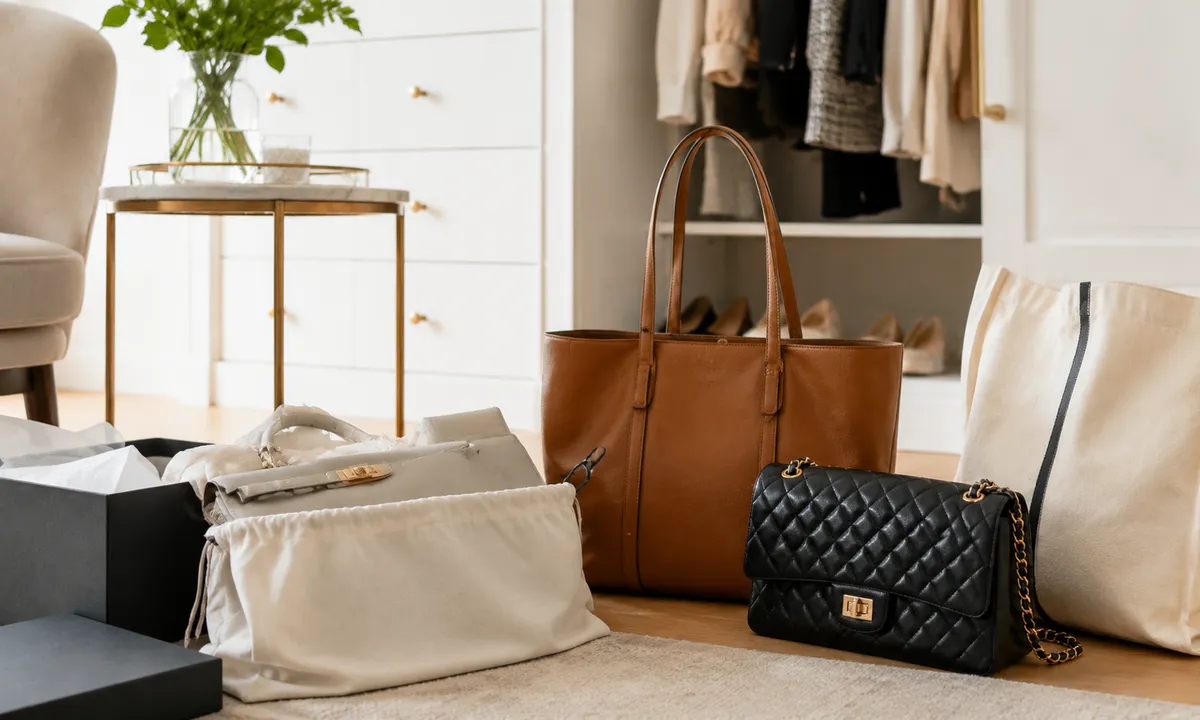
Somewhere around the third time a handbag needs to go in for “conditioning” at a cost that rivals a weekend away, the glamour starts to thin. Designer handbags have an extraordinary talent for making their owners feel both lucky and quietly anxious at the same time.
The bag that once felt like an arrival can start to feel like a liability within a year or two. It cannot go in the rain. It cannot sit on a floor. It needs its dust bag, its tissue stuffing, its occasional trip to a specialist. And all of this is on top of the original price, which for a mid-tier “entry-level” piece from a French house has quietly crept past the thousand-pound mark.
Leaving that world behind did not feel like a sacrifice. It felt, eventually, like putting down something heavy.
What the Real Cost Actually Looks Like
The sticker price is only the beginning. A popular structured tote from a well-known Italian brand costs somewhere between eight hundred and sixteen hundred pounds depending on the season and the colourway. But add the inevitable hardware repair eighteen months in, the professional cleaning after a light scuff, and the cost of replacement when the lining starts to pill, and the per-year figure starts to look very different from what was originally justified at the till.
Then there is depreciation. A handful of styles from a small number of houses hold or increase their value. Everything else loses it, and loses it fast. The mid-range crossbody bought two years ago for six hundred and fifty pounds resells for, at best, two hundred and eighty. That gap is the real price of ownership, and it rarely appears in the mental arithmetic people do before buying.
Switching to non-designer bags over the course of roughly three years freed up a sum that comfortably covered a short-haul holiday, a new winter coat from a proper tailor, and still left money sitting in an account doing nothing dramatic but present. The maths is not complicated. What takes longer to resolve is the feeling.
The Style Question, Taken Seriously
The concern that giving up designer bags means giving up style is worth engaging with honestly rather than dismissing. Logos do carry social weight. A recognisable monogram reads as a signal, and that signal has a real effect on how others perceive an outfit and, to be frank, on how the wearer feels about themselves. Pretending otherwise would be dishonest.
But style and branding are different things, and conflating them is exactly the habit that keeps people spending money they would rather not spend. Style lives in proportion, material quality, colour, and how a piece sits against everything else worn with it. A bag in a beautiful warm tan leather, structured with a clean silhouette, reads as considered and expensive even when it comes from a small Spanish manufacturer nobody has heard of. What it lacks is the specific recognition of a logo. That recognition is worth less to personal style than most people assume.
The brands worth knowing about are not necessarily the quiet luxury names that have simply replaced one set of status markers with another. They are the manufacturers who have been making leather goods for decades without a fashion calendar: Portuguese workshops, smaller Italian factories that supply larger houses but also sell under their own name, British saddlers whose bags happen to work perfectly well in a city. These producers compete on construction rather than cachet, which tends to mean thestitching is tighter, the leather is fuller, and the bag lasts longer than the equivalent from a heritage house that now subcontracts much of its production.
How to Actually Replace a Bag You Love
The practical challenge is knowing what you are actually buying when a logo is removed from the equation. Designer bags make their quality claims implicitly through brand authority. Without that shortcut, a buyer has to learn to read a bag for themselves.
Leather grain matters more than colour. Full-grain leather, which retains the hide’s natural surface, will develop a patina and improve over time. Corrected-grain leather, sanded smooth and embossed, looks uniform when new and deteriorates without gaining character. The weight of a bag when empty is a reasonable indicator of the leather thickness. Handles that arestitched rather than glued at the attachment point will survive the stress of daily use considerably longer.
Hardware is the other variable. Brass zips and clasps tarnish but can be polished and will not flake. Plated metal, common at lower price points, chips within a year of regular use. Running a fingernail along the edge of a zip pull reveals whether it is solid or hollow.
None of this requires expertise. It requires about ten minutes of attention and a willingness to handle the bag before buying it.
The Specific Bags That Filled the Gap
A structured tote in cognac leather from a Portuguese brand (Beatriz Hansen, though there are several comparable names) cost two hundred and forty pounds and has been in daily rotation for going on two years without a single repair. The leather has darkened pleasantly at the corners. The lining, a natural cotton canvas, has survived being treated as a bag rather than an investment.
For evenings, a small rectangular clutch from a British leather goods maker came in at a hundred and ten pounds. It does not require a dust bag. It does not need to be kept away from radiators. It gets used, which is the point of owning something in the first place.
The crossbody that replaced a much more expensive equivalent came from a small Italian workshop that sells primarily through its own website. Eighty-five euros, thick vegetable-tanned leather, a simple buckle closure. Two years on it looks better than it did on delivery, which is exactly the trajectory that the designer alternative, at seven times the price, conspicuously failed to follow.
What Takes Getting Used To
The adjustment is not about quality or style. Those resolve themselves quickly once the right pieces are found. The adjustment is psychological, and it is worth naming plainly.
There are moments, particularly in certain professional or social settings, where a recognisable bag functions as a kind of shorthand. It signals belonging, ease, a particular relationship to money and taste. Opting out of that signalling feels conspicuous at first, in the same way that leaving a group chat feels conspicuous even if nobody mentions it.
What becomes apparent over time is that this feeling fades, and what replaces it is something quieter but more stable. A bag chosen on its own terms, because of how it is made and how it functions, carries no anxiety with it. It can be put on a pub floor. It can get caught in the rain. It is a bag. Using it without ceremony turns out to be one of the more underrated pleasures of owning something well-made.
The One Case Where Designer Bags Still Win
A very small number of styles from a very small number of houses do retain value, and occasionally appreciate. The canonical examples are well-documented and heavily discussed in resale communities. For someone buying deliberately with resale in mind, treating a specific bag as a held asset rather than a worn object, the investment logic holds in specific conditions.
The catch is that this applies almost exclusively to bags that are kept in near-perfect condition, often barely used, and sold at the right moment through the right channels. That is not owning a handbag. That is a different activity entirely, closer to holding a piece of jewellery in a safe than to carrying something through a normal day.
For everyone else, the financial case for designer bags as an investment rests on the exceptional cases being mistaken for the general rule.
Where the Saved Money Actually Went
Three years of buying well-made non-designer bags instead of the alternative freed up, in rough terms, between four and five thousand pounds. Some of that went on travel. Some went on clothes that were bought more slowly and more carefully, which meant better things and fewer of them. A chunk went on nothing in particular, which is its own form of freedom.
The wardrobe that resulted is more coherent than the one it replaced, partly because each piece was chosen for itself rather than for what it represented. The bags in it get used without calculation. The cognac tote sits on the kitchen table most mornings, keys and a book already inside it, ready without ceremony.