


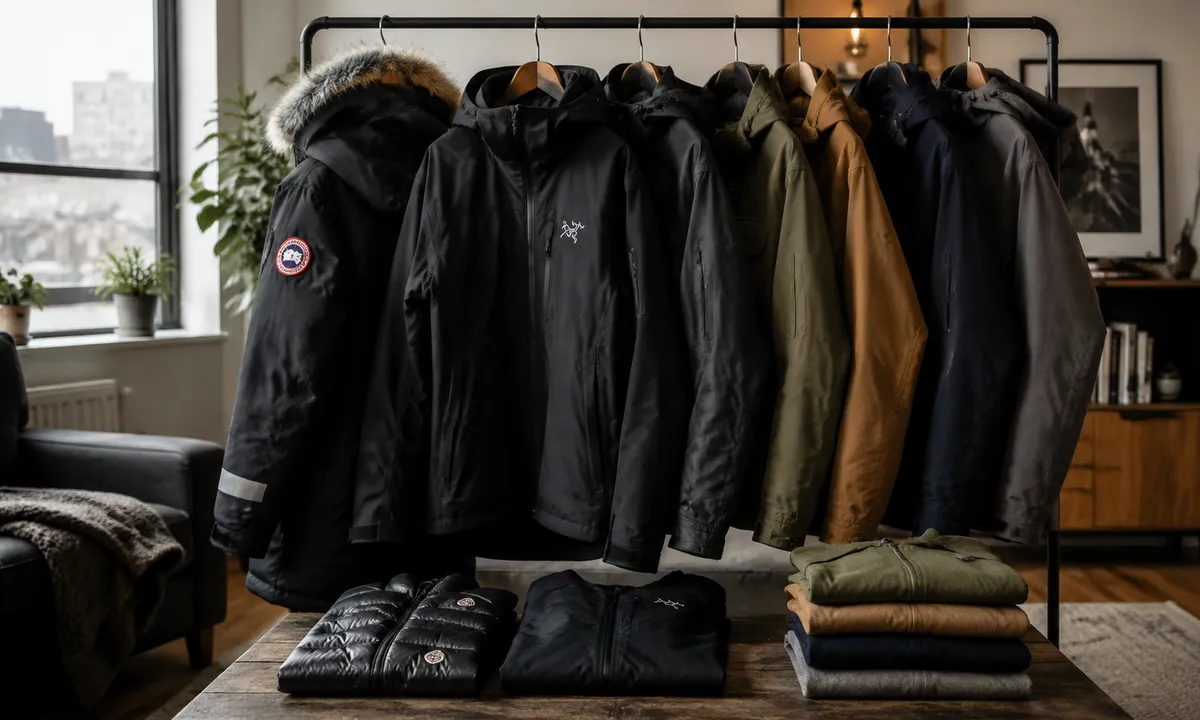
Canada Goose retails its Expedition Parka at around $1,150. Arc’teryx pushes its Beta AR jacket past $800. Moncler coats regularly cross $2,000 without a second thought. These are not aspirational prices in disguise; they are the baseline for a certain tier of outerwear, and the industry has spent decades building the case that nothing cheaper can honestly compete.
That case deserves a harder look.
What the Premium Price Actually Buys
The honest answer is: some of it is engineering, some of it is material sourcing, and a portion of it is brand equity that functions more like a luxury tax than a performance premium. The proportions depend entirely on which brand and which jacket you are holding.
Arc’teryx sits closest to the engineering end of the spectrum. Its Gore-Tex Pro laminate construction, field-tested in conditions that would ruin most shells in a season, represents a genuine technical achievement. The seam taping is thorough. The zippers are YKK Aquaguard, specified to handle prolonged exposure to rain and snow without binding or delaminating. For someone spending serious time in the mountains, those details translate into a jacket that performs where a cheaper alternative might fail at hour three of a wet ridge traverse.
Canada Goose built its reputation on down fill power and Arctic-grade temperature ratings. Its duck and goose down is sourced and certified, its outer shells are wind-resistant, and the brand’s early history in outfitting researchers and film crews in genuinely extreme cold gives it a credibility that held up through decades of scrutiny. The Expedition Parka in negative-forty-degree weather earns its keep. The same jacket in a city that sees two weeks of real cold per year is an entirely different value proposition.
Moncler is a different case. Its heritage is alpine, but its current market position is fashion-forward luxury. The down quality is excellent, the craftsmanship on the stitching and hardware is visible and real, and the silhouettes are considered. What a buyer is also paying for, openly and without apology, is the quilted logo panel and the social signal it carries. This is not a critique so much as an honest description of what the product has become.
Where the Mid-Range Has Genuinely Caught Up
Eddie Bauer, L.L. Bean, Patagonia at its lower price points, and Columbia’s premium sub-lines are making jackets in the $150 to $400 range that would have seemed implausible fifteen years ago at that price. Fill power on insulated jackets has climbed. Waterproof-breathable membranes that were once proprietary to Gore have been joined by competitive alternatives. Patagonia’s H 2 No fabric performs creditably in sustained rain. Columbia’s OutDry Extreme laminate is legitimately impressive for its cost.
The seam taping is sometimes partial rather than fully taped, and a careful comparison with an Arc’teryx shell reveals differences in construction detail that experienced buyers will notice. The zippers on a $200 Columbia shell are not Aquaguard throughout. The baffles on a $250 Eddie Bauer down jacket are not as precisely engineered as those on a Canada Goose piece. These are real gaps, and anyone who pretends otherwise is selling something.
But for the overwhelming majority of conditions most people actually encounter, the functional gap is modest. A week of travel in a cold city, a ski weekend where the lifts close in a blizzard, a long autumn commute through rain: all of these fall within territory where a well-chosen mid-range jacket performs at a level that would satisfy ninety percent of wearers who would have otherwise spent four times as much.
The Durability Question, Answered Honestly
Premium brands argue longevity. Pay more once, wear it for a decade. The argument has merit, but it comes with conditions that rarely get stated plainly.
An Arc’teryx jacket used hard and maintained properly, with its DWR treatment refreshed every few seasons and stored correctly, can outlast several rounds of cheaper alternatives. The same jacket worn casually, tossed in a closet, machine washed on the wrong cycle, loses a measurable portion of that longevity advantage. The premium jacket’s durability edge is real, but it requires an owner who is willing to treat the thing as a long-term investment rather than an article of clothing. Many buyers, even well-intentioned ones, do not keep that end of the deal.
Mid-range jackets are more forgiving of casual maintenance, partly because the expectation embedded in the price is different. A $300 Patagonia Torrentshell that gets washed too often and starts to lose its face fabric DWR after four years has still delivered value that holds up under scrutiny. The owner replaces it at year five, still having spent less total than a single premium shell, and gets the benefit of whatever incremental improvements the newer model carries.
Repairability is a genuine point in the premium column. Arc’teryx has a repair program. Canada Goose has expanded its service options. Getting a zipper replaced or a seam re-taped on a jacket this expensive makes financial sense in a way it simply does not on a $200 shell, where repair costs can approach replacement value uncomfortably fast.
The Conditions That Actually Justify the Spend
A backcountry skier logging serious vertical every week of a long winter has a reasonable case for the Arc’teryx Alpha SV. The jacket will be tested in ways that expose construction quality, and the breathability at high exertion in wet snow is a category where the premium laminates measurably outperform the field. At that level of use, the price-per-use calculation shifts in a direction that starts to make sense.
Someone stationed or traveling in sustained extreme cold, the kind that sits at negative twenty Fahrenheit for weeks rather than occasional bitter nights, has a legitimate reason to look hard at Canada Goose’s warmest ratings. Not every brand at any price builds for that window of use, and the warmth-to-weight engineering at the top tier remains genuinely differentiated.
Professional guides, expedition members, search and rescue workers: these are the buyers the premium technical brands were originally designed around. The marketing has since expanded far beyond them, but the products still reflect their original purpose in ways that matter when the stakes are actual.
The Urban Winter Coat and the Honest Math
The bulk of premium outerwear is bought and worn in cities. It goes from apartment to car to office to restaurant, occasionally faces a brisk walk of ten or fifteen minutes, and spends most of its life hanging in a mudroom or draped over a chair. Under these conditions, the performance engineering that justifies the price is almost entirely irrelevant.
This is where the honest mid-range case becomes overwhelming. A well-fitted Mackage or Aritzia Super Puff at $350 to $500 delivers warmth, style, and adequate weather resistance for urban winters with no meaningful shortfall versus a $1,200 Canada Goose for the same use case. The fill power difference is real on a spec sheet; in a city that dips to fifteen degrees Fahrenheit for a few weeks annually, it is not real in practice.
The argument that shifts everything back toward premium for this buyer is purely social. The logos are recognized. The signal is broadcast and received. In certain professional or social circles, this carries weight that the buyer has decided is worth the difference. That is a legitimate choice, but calling it a performance decision obscures what it actually is.
Sustainability Claims Across Both Tiers
Both sides of this market have sustainability messaging, and both sides should be read with some skepticism. Premium brands point to responsible down certification, repair programs, and longevity as environmental arguments. Mid-range brands increasingly advertise recycled fill and shell materials. Neither story is complete.
A jacket that lasts fifteen years has a lower environmental footprint per wear than one replaced every four, all else being equal. The premium durability argument has genuine environmental logic embedded in it. The complication is that a jacket replaced every four years because the owner wanted something new is not a product failure; it is a behavior pattern that applies across price points and undermines the longevity argument regardless of build quality.
Patagonia’s repair and resale infrastructure is legitimately differentiated in the mid-range space, worth noting for buyers who take the environmental calculus seriously. Its Worn Wear program has processed a substantial volume of returned and repaired garments, which is a real operational commitment rather than a marketing footnote.
Fit, Finish, and the Detail That Separates Them at the Seam
Hold a $900 Arc’teryx shell next to a $280 Marmot shell and the differences are tactile before they are technical. The Arc’teryx fabric has a density and drape that the Marmot does not match. The zipper pulls move with a precision that feels considered. The hood articulation, with its laminated brim that holds its shape, is a piece of design work that the mid-range cannot replicate at price.
These details matter to buyers who handle a lot of gear and have developed preferences. They matter less to buyers picking up their first serious shell in a store. The problem is that marketing has succeeded in making everyone feel like the first type of buyer, whether or not the conditions of their lives justify it.
A $300 Outdoor Research jacket in a storm at ten thousand feet keeps a capable hiker dry and warm. The same hiker in an Arc’teryx jacket is also dry and warm, with better breathability during the climb and a hood that tracks their head movements more naturally. The first experience is adequate and honest. The second is measurably better in ways a skilled user will notice and appreciate. The question is whether the person asking the question is actually going to be on that ridge, and most of the time, the answer is no.