


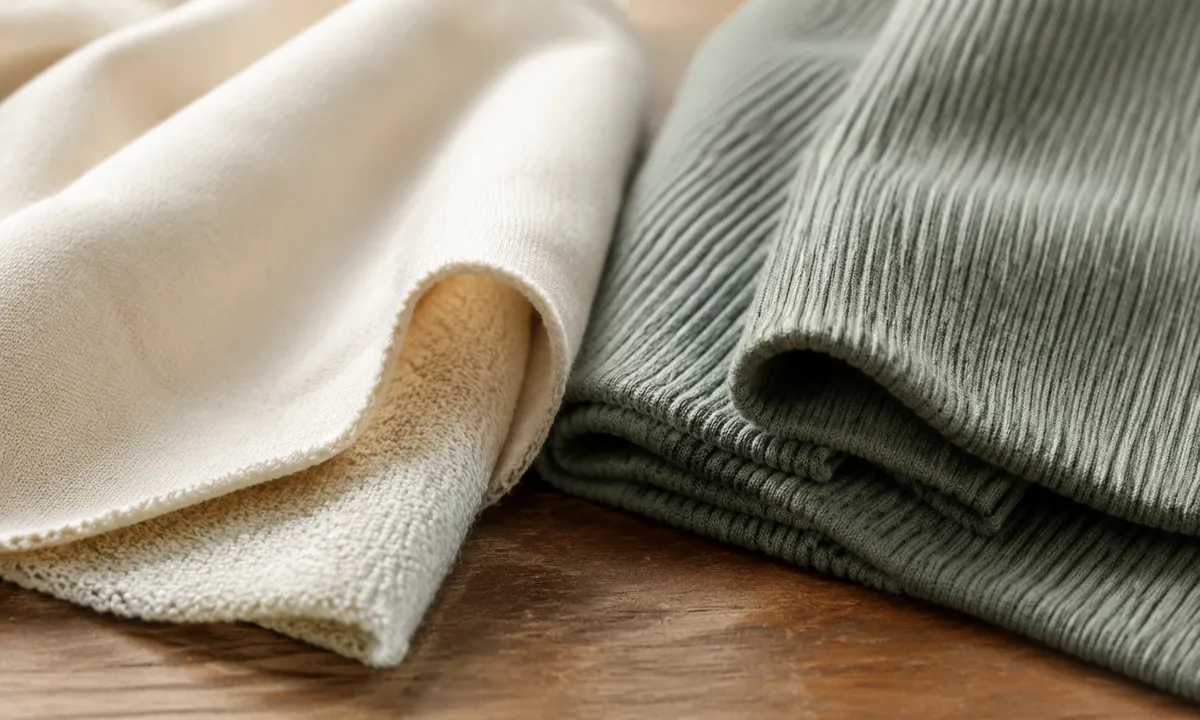
French terry and rib knit sit at opposite ends of the casual fabric spectrum, even though both end up in the same category of clothes: the kind you reach for on a Saturday morning without thinking too hard about it. Understanding the difference matters more than most people expect when they are shopping for a casual dress, because the two fabrics behave completely differently on the body, wear differently across seasons, and give a garment an entirely different silhouette.
What Each Fabric Actually Is
French terry is a knit fabric with a smooth face and looped pile on the reverse side. Those loops are what distinguish it from regular jersey, which is smooth on both sides. The loops trap air and give the fabric a slight loft without reaching the thick, napped warmth of fleece. A French terry dress has a clean, matte surface that reads as casual but put-together, somewhere between a sweatshirt and a ponte knit in terms of how dressed-up it looks.
Rib knit is defined by its structure: alternating columns of knit and purl stitches that create vertical ridges. That structure makes the fabric extremely stretchy in the crosswise direction and highly elastic, meaning it snaps back firmly after being stretched. A dress cut from rib knit will hug and move with the body in a way French terry simply does not.
Both are almost always made from cotton, or cotton blended with a small percentage of polyester or modal for stability and softness. The blend percentages matter: a rib knit with 5 percent spandex recovers more aggressively than a 100 percent cotton rib, and a French terry with a higher poly content holds its shape through more washes.
How They Sit on the Body
This is where the two fabrics diverge most sharply, and where the choice becomes personal rather than just technical.
French terry is a medium-weight fabric with relatively low stretch. Depending on the cut, a French terry dress can be slightly A-line, boxy, or relaxed without being clingy. It has enough body to hold a shape on its own, so it does not require the body inside it to do any work. That quality makes it forgiving. Someone who prefers coverage, ease of movement, or simply does not want a fabric that tracks every contour will find French terry cooperative in a way that rib knit rarely is.
Rib knit does the opposite. Its elasticity means it follows the body closely regardless of what the pattern dimensions suggest. A rib knit dress that measures generously when laid flat will stillcling when worn, because the fabric is designed to stretch and recover. This can be exactly what someone wants: that fitted, body-conscious look has been central to casual fashion for years, from the thin-rib mini dress to the heavier sweater-knit midi. But it means the fit cannot be hidden or worked around. The fabric will find whatever shape is underneath it.
Weight, Season, and Comfort in Real Conditions
French terry runs heavier. A standard French terry fabric weighs somewhere in the range of 280 to 380 grams per square meter, which puts it firmly in the fall and spring category for most climates. It is too warm for a hot July afternoon and too light for real winter, which makes it one of the most reliable transitional fabrics available. The looped interior also makes it feel pleasantly substantial without the bulk of a fleece, so it reads as cozy without being shapeless.
Rib knit covers a wider weight range. Thinrib, the kind used in form-fitting tank-style or summer slip dresses, can be quite lightweight and breathable. Heavier rib, the kind that goes into sweater dresses and fall knits, gets thick and insulating. The range meansrib knit is genuinely versatile across seasons depending on the gauge, but a shopper who does not know the weight going in can be surprised: a dress described as rib knit might be paper-thin or genuinely warm.
Both fabrics are soft against the skin, which is part of why they dominate casual dress categories. French terry’s loops are particularly gentle, since the raw fiber faces inward rather than directly against the body. Rib knit’s ridges create mild texture on contact, which most people find neutral but some find slightly irritating against sensitive skin over a long day.
What Each One Looks Like After Six Months
French terry holds up well with normal care. Because it is not under constant tension, the fabric does not pill aggressively or lose its shape from wear alone. Washing it inside out in cold water is standard advice for preserving the loops. The main failure mode is pilling along areas of friction: under the arms, across the seat, anywhere the fabric rubs repeatedly. Higher cotton content tends to pill more than a poly blend. Over many washes, French terry can soften further, which most people consider an improvement.
Rib knit’s durability depends almost entirely on the quality of the yarn and the fabric’s elastic recovery. A cheaprib knit dress, especially one without any spandex, will stretch out at the neck, hem, and anywhere the rib has been under repeated strain. Once a rib knit loses its snap, it looks worn in a way that is hard to overlook: the ridges flatten, the fit loosens, and the whole garment reads as old. A better-quality rib, or one with a well-considered spandex percentage, resists this for much longer. The difference between a rib knit dress that costs twenty dollars and one that costs ninety is often entirely in the fabric recovery.
Styling Range: Where Each Fabric Goes and Where It Stops
A French terry dress can be styled up or down with less effort than a rib knit. Because the fabric has a neutral, slightly matte surface, it takes well to both sneakers and sandals, a denim jacket or a blazer. The relaxed fit of most French terry styles is close enough to intentional that it reads as deliberate rather than sloppy. This makes it a reliable choice for someone who wants one garment to carry them from a weekend errand into a casual lunch without a costume change.
Rib knit, because it is body-conscious by nature, reads as more deliberate and slightly more fashion-forward. That can be a strength: a fitted rib knit dress with heeled boots and a leather jacket has a specific, cohesive look that French terry cannot quite achieve. But that specificity also limits it. A rib knit dress looks odd under a boxy, oversized outer layer; the proportions fight each other. It is harder to dress down into something that looks casual rather than just underdressed.
There is also a formality ceiling to consider. French terry hits it lower: the fabric’s looped texture and athletic heritage keep it from reading as anything more than smart casual regardless of how it is cut. Rib knit, particularly in a finer gauge or a longer silhouette, can push closer to polished. Arib knit midi dress in a deep neutral reads as evening-appropriate in a way that French terry simply does not.
The Case for Choosing Based on Cut, Not Just Fabric
One thing that gets lost in fabric comparisons is how much the cut of a specific dress changes the experience of the fabric. A French terry dress cut on the bias moves differently from one cut on the grain. A rib knit dress with a flared skirt sits completely differently from a straight-cut one, because the ribbing runs horizontally and stretches as the skirt swings rather than following the leg vertically.
Rib knit cut into a tiered or smocked style loses some of its characteristic cling and gains a softness closer to French terry’s relaxed quality. French terry cut into a tighter, more structured silhouette with a defined waist and tapered hem looks significantly more put-together than a boxy sweatshirt dress in the same fabric. The fabric sets the baseline; the cut determines how far from that baseline the final garment actually lands.
A shopper who dismisses rib knit entirely because it seems too fitted, or who avoids French terry because it reads as too casual, may be reacting to specific cuts they happened to encounter rather than to the fabric itself. Both materials have a wider range than their most common expressions suggest.
Warmth in the Wash and the Real Cost of Getting It Wrong
French terry is relatively forgiving in the laundry because its structure is not held under tension. A moderate dryer cycle will shrink it somewhat, which is worth accounting for upfront, but it will not dramatically distort the garment. The loops can come out slightly matted from high heat, but they recover with a gentle tumble and a shake.
Rib knit requires more care, specifically because heat and agitation attack elastic recovery. A rib knit dress washed in hot water and dried on high heat will emerge smaller, stiffer, and with reduced snap. The ribbing may torque slightly off-grain. Once this happens, it is largely permanent. Air drying rib knit flat is the standard recommendation for preserving its shape, which means factoring in longer turnaround time between wears.
For someone who throws everything in together on warm and calls it done, French terry is the lower-risk choice. For someone willing to be deliberate with laundry, therib knit investment holds up. The real cost of choosing wrong is not just the dress itself but the habit it requires.