


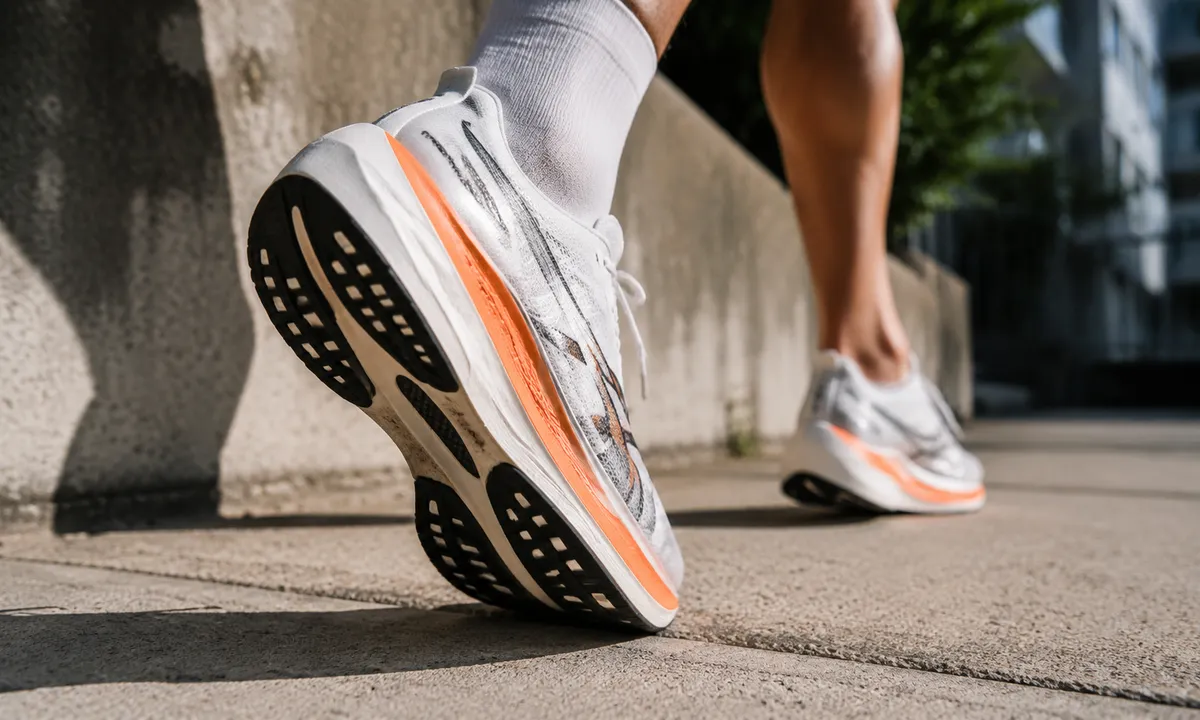
Carbon plate shoes cost between $180 and $260 at most running specialty shops. They look fast just sitting on the shelf. The curved sole, the stiff midsole foam, the aggressive toe spring, the whole geometry says something about speed. So when a casual runner, someone doing a few miles three or four mornings a week, picks one up and thinks about buying it, the question they’re really asking is whether the shoe can do some of the work for them.
The short answer is: a little, but probably less than the shoe costs, and less than the marketing implies.
What the Plate Actually Does
The carbon fiber plate is embedded in the midsole, usually sandwiched inside a thick bed of highly resilient foam like Nike’s ZoomX, Adidas’s Lightstrike Pro, or ASICS’s FF Blast Turbo. The plate stiffens the forefoot, which changes how the shoe bends through the toe-off phase of the stride. It also works in combination with the rocker geometry of the outsole to help propel the foot forward rather than letting it flatten and drag.
The energy return is real. These foams store and release more energy than the EVA midsoles in traditional running shoes. In controlled settings, elite runners have shown measurable improvements in running economy while wearing carbon plate shoes, meaning they consume less oxygen at the same pace. That effect has been documented in published research and is not in serious dispute.
The dispute is about who it helps, how much, and under what conditions.
The Efficiency Curve and Where Casual Runners Fall On It
Elite runners benefit most from these shoes because of how they run. A sub-2:10 marathoner spends almost no time with their foot flat on the ground. Their stride is quick and stiff, their cadence is high, and their foot strike loads the shoe in the specific way that lets the foam compress and the plate snap energy back efficiently. The shoe was designed around that kind of biomechanics.
A casual runner doing a 10 or 11 minute mile tends to have a longer ground contact time, a lower cadence, and often a heel strike that lands well behind the body’s center of mass. That pattern loads the midsole differently. The foam still feels soft and springy, but the plate’s propulsive effect is reduced when the leverage geometry is off. Some of the energy that the shoe is designed to return simply gets absorbed in a stride that the plate was not designed for.
This does not mean the shoe does nothing. Even casual runners typically feel the difference. The rocker shape takes some of the work out of pushing off, and the thick foam cushions each landing generously. Over a long run, that subjective comfort is genuine. The question is whether it translates into a real, repeatable speed or efficiency gain at a casual pace, and the evidence for that is much thinner than the marketing suggests.
The Durability Problem No One Puts On the Box
The foams that make these shoes work, particularly the nitrogen-infused supercritical foams in the top-tier models, compress and degrade faster than traditional EVA. Most people in the running community cite 300 to 500 miles as the useful life of a carbon plate racing shoe. For comparison, a well-built daily trainer with conventional foam can stay functional for 400 to 600 miles or more.
A casual runner logging 15 miles a week will hit 300 miles in about five months. At $230 a pair, that works out to a significantly higher cost per mile than a $130 daily trainer that lasts eight months at the same mileage. The math does not favor the carbon shoe if someone is treating it as their everyday runner rather than a race-day shoe worn sparingly.
The outsoles compound this. The thin, lightweight rubber on most carbon plate shoes wears through quickly on anything other than smooth pavement. Trail gravel, sidewalk cracks, and gritty paths eat the outsole faster than the midsole foam gives out. A runner who does most of their miles on varied surfaces will see that cost-per-mile figure climb even higher.
Injury Risk Is Not Simple
There is a recurring concern in running injury circles that carbon plate shoes, by altering stride mechanics, shift load onto muscle groups and tendons that casual runners may not have conditioned. The stiff forefoot encourages a more forward foot strike, and the rocker shape reduces ankle flexion. For runners whose calves and Achilles tendons are accustomed to a different demand, that shift can produce soreness or strain, particularly if someone simply swaps their old shoes for carbon plates and keeps the same training volume.
This is not a guarantee of injury. Plenty of casual runners wear these shoes without any problem. The general understanding in sports medicine is that abrupt changes in footwear can stress tissues in ways that gradual adaptation does not. Whether that risk is higher with carbon plate shoes than any other significant shoe change is something researchers are still working out, and the honest answer is that nobody has a clean, settled number for it.
The practical implication is simple: a casual runner who buys a carbon plate shoe and immediately uses it for all of their running is taking on more transition risk than one who introduces it gradually, maybe for the last few miles of a long run, then builds from there.
What They Are Good For, Even at a Casual Pace
Race day is the clearest use case. Someone running a 5K fun run, a local 10K, or even a half marathon once or twice a year is a reasonable candidate for a carbon plate shoe, used specifically on race day and for a handful of long training runs beforehand to get used to the feel. The shoe does not need to deliver an elite-level efficiency gain to be worth it for that purpose. Even a modest improvement in comfort and turnover, combined with the psychological effect of wearing something that feels purposeful and fast, can make a real difference in how a casual runner finishes a race they have spent months preparing for.
There is also something to be said for motivation. Some runners simply enjoy running more in a shoe that feels lively underfoot. If a $200 pair of shoes makes someone look forward to their Wednesday morning miles in a way that a $110 trainer does not, the math changes. Running more consistently over months and years will improve performance more than any shoe choice, and if the shoe is part of what makes consistency happen, it has earned its place.
The Shoes That Sit Between
The running shoe market has filled in around the carbon plate models with a category often called “plated trainers” or “daily carbon” shoes: shoes that use a carbon or nylon composite plate inside a more durable midsole foam, at a price point usually between $130 and $160. Examples include the Saucony Kinvara Pro, the New Balance FuelCell Propel, and various ASICS trainers. These are more durable, slightly less aggressive in their geometry, and designed for higher weekly mileage.
For a casual runner who is curious about what plated shoes feel like but skeptical of paying racing shoe prices for everyday miles, these trainers are a more sensible entry point. The plate effect is softer, the longevity is better, and the price doesn’t sting as much when the midsole eventually packs out.
The Honest Accounting
Carbon plate shoes do something. They are not a scam and they are not a revolution. At casual running paces, the measurable efficiency benefit is smaller than it is for elite runners, the durability is a real cost concern if the shoe becomes a daily driver, and the injury transition risk is worth taking seriously rather than ignoring. For a race or two a year, worn deliberately and broken in sensibly, they are a reasonable luxury with a plausible upside. For the Tuesday and Thursday runs in October drizzle, a well-cushioned trainer built to last 500 miles is probably doing more honest work.