


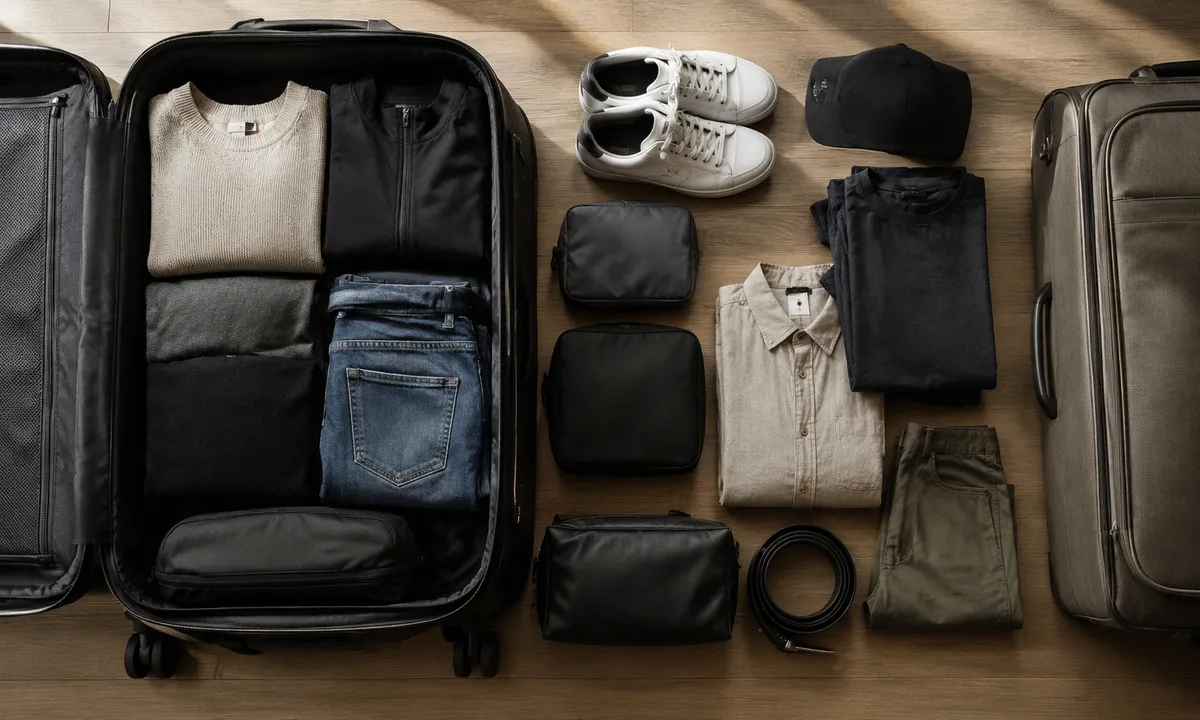
Two bags standing at opposite ends of a spectrum have shaped modern travel culture more than any single airline policy or packing list. One lives in the overhead bin, demands discipline, and forces decisions at home rather than at baggage claim. The other accepts abundance, checks in beneath the plane, and hands back a different kind of freedom at the cost of waiting by a carousel. Neither is a mistake. Both are a strategy.
The carry-on wardrobe is not a minimalist philosophy or a flex about owning less. It is a set of hard constraints that, once accepted, make clothing choices faster and sharper. A standard personal item plus a carry-on gives most travelers somewhere between 35 and 45 liters of usable space. Subtract shoes, toiletries, a laptop, and a rain layer, and the actual wardrobe footprint is modest. Four or five shirts. Three bottoms. Two pairs of shoes if the bulkier pair is worn on the plane. That compression is where the thinking happens.
Capsule-style packing works here not because it is fashionable but because it is arithmetic. Every piece has to pair with at least two others or it is a liability. A printed blouse that matches only one skirt is dead weight. A navy crewneck that works over a dress, under a blazer, or tucked into trousers earns its place three times over. This is not about owning a wardrobe of beige basics. It is about selecting pieces whose range of use is wide enough to justify the space they occupy.
Color range matters more in a carry-on context than it ever does at home. A traveler who packs two competing palettes, say warm earth tones and cool slate grays, ends up with pieces that cannot cover for each other. One dominant neutral and one accent color is the efficient structure. Everything mixes, nothing is stranded, and the visual identity of the outfits reads as intentional rather than assembled in a hurry.
Fabric Does Most of the Work
In a checked bag, fabric choice is a preference. In a carry-on, it is a structural decision. Merino wool has become the standard recommendation for a reason that has nothing to do with trend: it resists odor across multiple wears, compresses without holding a crease, and transitions between temperature ranges without requiring an additional layer. A merino shirt worn on a seven-hour flight and then out to dinner in a warm city does not announce itself. That flexibility is worth the higher price tag per piece.
Linen is the complicating factor. It breathes beautifully in humid heat, packs into almost nothing, and looks intentionally relaxed when worn well. It also wrinkles in the bag with a commitment that other fabrics do not. Whether that matters depends entirely on the trip. A coastal summer stay with a low-dress-code environment tolerates linen’s rumpled quality. A schedule of client meetings or formal evenings does not. The carry-on traveler has to be honest about which world the trip actually inhabits.
Synthetics and their blends sit in the middle: wrinkle-resistant, fast-drying, and available in cuts that read as business casual at a distance. The quality ceiling is lower, but for active itineraries with laundry access, performance-fabric trousers and shirts earn their keep in ways that a heavier cotton or silk cannot match.
What the Checked Bag Actually Buys
A checked bag is not a failure of discipline. It is a trade of speed and certainty for volume and flexibility. That trade makes sense under specific conditions, and the carry-on evangelist who refuses to acknowledge this is working from ideology rather than observation.
Multi-climate itineraries are the clearest case. A trip that moves from a coastal city in early spring to a mountain region still carrying cold weather, then to a southern country with summer heat, cannot be solved by a 40-liter bag without real sacrifice. The down jacket that compresses to the size of a football still takes up that football-sized footprint, and once the hiking boots go in, the arithmetic breaks. Forcing this into a carry-on produces an outfit strategy so constrained that the trip itself feels managed rather than experienced.
Formal occasions create a similar pressure. A single structured blazer survives a carry-on if packed strategically. A full suit, particularly one with trousers that need to arrive uncreased, is another question. Wedding guests, conference presenters, or anyone expected to wear ceremony-appropriate clothing over several days will find a checked bag cheaper in terms of stress than any clever rolling technique promises.
There is also the question of footwear. Shoes are the densest problem in packing. A pair of heeled sandals, a pair of trail runners, and a pair of dress shoes represent a volume and weight that simply cannot share a carry-on with a full wardrobe. The checked bag traveler solves this by accepting the bag fee as a line item in the trip budget rather than an avoidable inefficiency.
The Laundry Variable
Access to laundry changes the carry-on calculus completely. A ten-day trip with one laundry stop midway through operates on different math than a ten-day trip with no washing facilities. The traveler who books apartments with machines, stays in hotels with same-day service, or carries a small packet of travel soap for sink washing is not packing for ten days. They are packing for four or five days and repeating the cycle. That is a genuine carry-on-viable strategy that the checked-bag traveler may not have thought through.
Laundry service at hotels runs at prices that surprise travelers who have not used it before. A single dress shirt returned pressed and folded can cost the equivalent of a budget airline bag fee. At that price, the carry-on efficiency argument weakens unless the traveler is doing their own washing. This is not a reason to abandon the carry-on approach, but it is a cost that belongs in an honest comparison.
Building the Carry-On Wardrobe Around a Trip Type
The carry-on wardrobe that works for a five-day urban trip to a single city is not the same wardrobe that works for two weeks of mixed terrain. Each needs its own architecture.
For the short urban trip, the efficient structure is roughly: two pairs of pants (one casual, one smart enough to read as dinner-appropriate), three to four tops in the same color family, one layering piece, one pair of walking shoes worn on the plane, and one pair of shoes in the bag. That covers most of what a city itinerary asks for without redundancy. The evenings are handled by upgrading the tops or adding a single piece of jewelry rather than packing separate evening outfits.
For a longer mixed trip, the question is whether to check a bag or accept that the itinerary requires a different wardrobe philosophy altogether: renting, buying locally, or simply wearing things more than once without apologizing for it. The third option is underused. Travelers who plan on wearing the same trousers four days out of seven, rotating the tops and accessories to shift the look, cover far more ground with far less luggage than the traveler trying to pack a different outfit for every day.
Where Checked Bag Travelers Lose Ground
The checked bag becomes a trap in proportion to the traveler’s tendency to overpack. The volume available invites filling, and the result is a 23-kilogram bag on a seven-day trip where twelve kilograms of it never leaves the hotel room. The cost is not just the bag fee. It is dragging a heavy suitcase up stairs in a building without a lift, negotiating cobblestone streets with wheels that catch in every gap, and spending the first hour of every new destination managing logistics rather than moving through them.
There is also the matter of what happens when the bag does not arrive. Delayed luggage on the outbound leg of a trip is not a rare edge case. For the carry-on traveler, this is not a category of problem that exists. For the checked bag traveler who packed everything including the toiletries and the only dress shoes, a delayed bag is the opening act of a trip spent in airport gift shops buying overpriced necessities.
The practical hedge is to treat the personal item or a day bag as a first-night carry-on regardless of whether the main luggage is checked. One change of clothes, all medications, a phone charger, and any irreplaceable items stay with the traveler on the plane. The checked bag then becomes a convenience rather than a single point of failure.
The Shoes on Your Feet Are Part of the Strategy
Experienced carry-on travelers treat the outfit worn to the airport as luggage. The bulkiest shoes go on the feet. The heaviest jacket goes on the body or over the arm at security. A structured tote or cross-body takes the place of a second bag and gets tucked under the seat. These are not hacks. They are just the natural consequences of taking the bag constraints seriously from the moment the trip begins.
A wool blazer worn onto the plane, folded neatly in the overhead bin, and put back on at the destination doubles as both a travel layer and a dinner-appropriate piece without occupying a square inch of the bag. That kind of thinking, applied consistently across every item, is what makes a 40-liter bag feel like more than it is.
The traveler who arrives in a city with a carry-on that actually contains what the trip requires, without the last-minute panic of overpacking or the anxiety of waiting at baggage claim, has not stumbled into that position. They made specific decisions, probably weeks before the flight, about which pair of shoes would go on their feet and which would stay home. That advance negotiation with the bag is the real discipline, and it starts long before the overhead bin closes.