


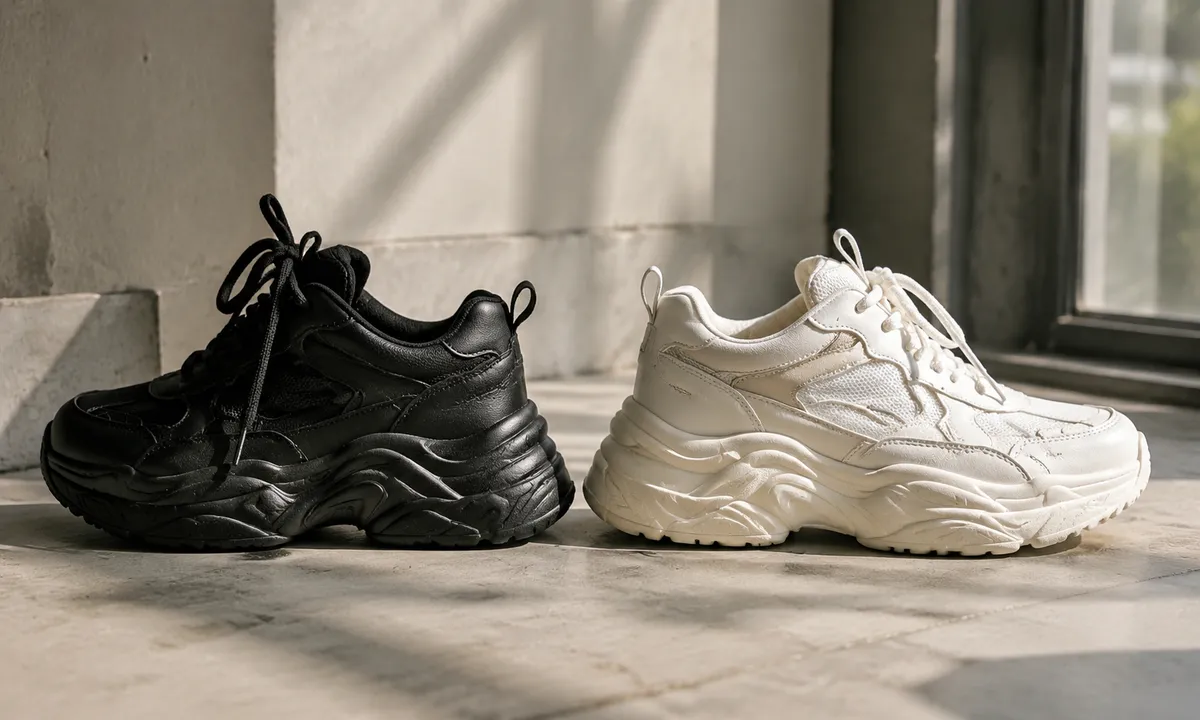
Chunky white sneakers and chunky black sneakers occupy different emotional territories, even when the silhouette is identical. Same platform, same exaggerated sole, same proportions borrowed from 1990s sportswear, yet the two colors pull an outfit in genuinely different directions. Choosing between them is less about style preference and more about understanding what each one actually does to the clothes above it.
What White Chunky Sneakers Actually Do to an Outfit
White draws the eye down. That is the first practical fact about wearing white sneakers with any outfit. A person standing across the room reads as grounded, finished, visually anchored at the foot. With chunky silhouettes specifically, that anchor becomes even more emphatic because the shoe has physical mass to back it up.
The traditional pairing advice says white sneakers brighten dark outfits. That is true, but incomplete. They also create contrast with light outfits, separating the foot from cream trousers or beige linen in a way that reads as deliberate rather than accidental. An all-white look with white chunky sneakers reads differently still: it collapses the outfit into one unbroken column, which elongates the body and photographs cleanly.
The real issue with white is maintenance. After a week of subway commutes, lunch spills, and sidewalk puddles, white leather scuffs, white mesh gathers grey around the toe box, and white rubber soles pick up a yellowish tinge that no amount of magic eraser fully reverses. For some wearers, that aging process is part of the appeal. Worn-in white chunky sneakers carry a record of use. For others it becomes a low-grade irritation, the subtle feeling that the shoe looks slightly off even when the rest of the outfit is carefully put together.
Seasonal instinct pushes white toward spring and summer. That instinct has a practical basis: a white sneaker against bare skin or lightweight cotton looks airy in a way it simply does not against heavy wool. Wearing white chunky sneakers in January with dark denim and a thick coat can work, but it requires the rest of the outfit to carry conviction, because the shoe creates a visual gap that the clothing above it has to bridge.
What Black Chunky Sneakers Actually Do to an Outfit
Black absorbs the foot into the outfit. Where white separates and highlights, black continues and deepens. This is useful in a very specific way: black chunky sneakers worn with dark trousers create a long unbroken line from the waist down, which reads as leaner and taller than the actual proportions warrant. The chunky sole adds height without the visual interruption a white or bright sneaker would introduce.
They work harder in low-effort situations. A person wearing black jeans, a grey sweatshirt, and black chunky sneakers has not made a statement, exactly, but the outfit coheres without requiring the black sneaker to carry anything. The shoe recedes into a base layer. That same grey sweatshirt with white chunky sneakers sits in a different register: slightly sportier, more intentional, more visible as a choice.
Black chunky sneakers have a natural home in the fall and winter wardrobe, not because of any rule about seasonal color but because the palette around them shifts. Camel coats, olive parkas, burgundy knitwear, forest green cargos, all of these tones sit comfortably against black without the eye-catching contrast that white would introduce. The sneaker becomes part of the outfit’s base rather than a feature of it.
The durability difference is not small. Black leather scuffs less visibly, black rubber soles stay presentable longer, and black mesh hides the kind of grime that accumulates inside a shoe over six months of regular wear. A pair of black chunky sneakers bought in September will look considerably more presentable the following April than an equivalent white pair worn through the same conditions. That is just a practical reality of the color, not a judgment about taste.
Specific Outfits and Which Color Serves Them Better
Wide-leg denim in a mid or light wash: white wins here without much contest. The pale denim and white sole blend at the bottom of the trouser leg, and the overall effect is loose and easy in a way the same silhouette with black sneakers does not achieve. Black sneakers under wide light-wash denim can look like the top and bottom halves of the outfit belong to different ensembles.
Tailored black trousers worn with a blazer: black chunky sneakers are the better move, and not because they match. The monochrome base with a sneaker instead of a dress shoe creates a specific tension, formal above, casual below, that reads as intentional and current. White chunky sneakers in the same outfit introduce a break that flattens the tailoring by pulling all the attention downward.
A flowy midi dress in a neutral tone: this is one case where both colors work and the choice comes down to the feeling the wearer wants. White sneakers push the look toward something relaxed and warm-weather casual. Black sneakers give the dress an unexpected edge, particularly in a darker neutral like charcoal, slate, or deep brown. Neither is wrong. The decision is genuinely about mood.
Monochromatic all-grey or all-black outfits: black chunky sneakers disappear into these and create that long unbroken column. White creates contrast, which can be striking, but it also adds a self-conscious quality, a sense that the shoe is the point of the outfit. Depending on the wearer, that is either exactly what they want or exactly what they are trying to avoid.
Shorts, particularly in the summer: white chunky sneakers feel native here. The exposed leg against a white platform reads as coherent. Black sneakers with shorts can work, but the chunky sole reads heavier against bare skin in a way that requires the rest of the outfit to have some visual weight to balance it.
The Case for Owning One of Each
Most sneaker conversations eventually arrive at this point, and it deserves a direct answer. The two colors genuinely are not interchangeable. Pulling a specific outfit together over a week of real life quickly reveals moments where one works and the other creates friction. The person who wears chunky sneakers regularly, across seasons, across different types of clothing, will use both colors differently enough that each earns its place.
The budget version of this is to pick the one that fits the actual wardrobe. Someone who mostly wears dark clothes in a northern climate where the sidewalks stay grey and wet for five months of the year will get more consistent use from black. Someone whose wardrobe runs toward warm neutrals, light denim, and summer cottons will reach for white more naturally and find the maintenance trade-off acceptable.
When the Choice Is Made by the Wardrobe, Not the Trend
The chunky sneaker trend has stretched long enough now that both black and white versions have settled into the wardrobe as permanent fixtures rather than seasonal statements. That longevity means the smarter question is no longer which color is having a moment, but which color maps onto the clothes a person actually owns and wears.
Pull out five outfits from the rotation. Hold each one mentally against a white chunky sneaker, then against black. If the white version creates a visual break that reads as awkward, that is data. If the black version disappears too completely and flattens the outfit, that is also data. The answer tends to become obvious quickly when the comparison is made against real garments rather than abstract preference.
Someone with a wardrobe of charcoal, navy, and olive who decides between a white and black chunky sneaker in a store fitting room is essentially deciding whether they want a shoe that contrasts with everything or one that anchors everything. Both are coherent choices. Contrast creates presence. Anchor creates length. The outfit standing in front of the mirror already knows which one it needs.