


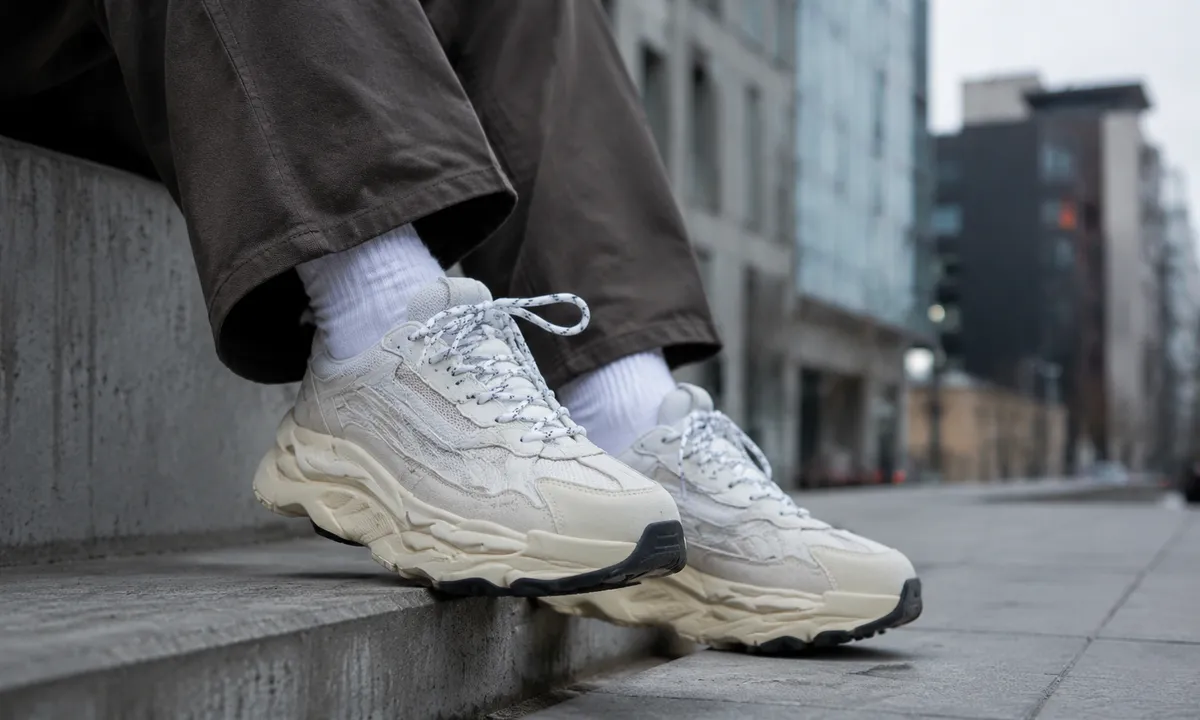
Oversized sneakers peaked somewhere around 2019, when chunky soles were piling up in the windows of every retailer from Footlocker to Dover Street Market. Five years on, the silhouette has thinned in certain corners of fashion media, and there is a reliable cycle of trend obituaries whenever a new clean profile starts getting traction. The question of whether oversized sneakers are still worth wearing is mostly a question of whether those obituaries are accurate.
They are not.
What “Oversized” Actually Covers
The category is wider than it looks. An oversized sneaker is not simply a shoe that runs large in sizing; it refers to a design language: thick midsoles often exceeding 35 mm at the heel, exaggerated toe box volume, outsoles that extend visibly beyond the upper’s footprint, and an overall silhouette that reads as sculptural rather than streamlined. The New Balance 990 series, the Nike Air Max 95, the SalomonXT-6, the On Cloudmonster, the Asics Gel-Kayano line: these all live in this territory in different ways, and they have wildly different reputations at the moment. Lumping them into one dismissal, or one defense, misses most of what is actually happening.
The genuinely played-out version is the fashion-house dad shoe, the deliberately ugly centerpiece that traded on deliberate ugliness as a statement. That specific conversation did run its course. But the oversized sneaker as a functional category, one chosen because it actually improves how a shoe performs or because its proportions work well with specific clothes, is doing fine.
The Stack Height Argument Is Real
Running shoe engineering moved hard toward stack height over the last several years, and that shift crossed over into lifestyle footwear in a way that has proven durable. The logic is simple: more cushioning material between the foot and the ground absorbs more impact across a long day. For someone standing on concrete for eight hours, or walking several miles through a city, the practical case for a thicker sole does not dissolve because a trend cycle turns.
What changed is that the stack is now often part of a more considered design rather than the entire statement. The Hoka Clifton, originally a running shoe that looked extreme when it appeared, is now a commonplace sighting in urban environments, worn by people who are not runners and are not interested in making a style declaration. They just find their feet hurt less. That is a durable purchase justification in a way that “it signals I know about fashion” simply is not.
How They Actually Wear With Clothes Now
The styling context for oversized sneakers shifted in the last few years, and that shift is what makes them more sustainable as a long-term wardrobe piece. When they first broke wide, the dominant pairing was slim trousers or tapered denim, chosen specifically to create contrast with the large sole. The shoe was the focal point of a deliberate outfit construction.
The more current approach treats the chunky sole as a proportion tool rather than a punchline. Wide-leg trousers and relaxed-fit jeans, both of which have held on longer than many predicted, actually need some visual weight at the base to avoid looking sloppy. A slim, low-profile shoe under a wide trouser leg tends to look deflated. The oversized sneaker provides an anchor. This is not a style hack unique to any one person; it is a proportion principle borrowed from how heavy work boots were worn in the 1990s and how platform soles operated in the 1970s, and it functions for the same reason each time.
There is also the outdoor-influenced silhouette that has settled into everyday dress over the past several years. The trail-running shoe aesthetic, chunky and technical, moves naturally between hiking contexts and city streets in a way that a sleek court shoe never really does. A pair of Salomon Speedcross or similar trail-influenced sneakers under straight-cut pants reads as coherent in 2025 in a way it would not have in 2010, simply because the cultural framing of outdoor gear as legitimate everyday style is now fully established.
When the Size Works Against You
Shorter people often find that very high-stacked or very voluminous sneakers shorten the visual line of the leg in ways that feel uncomfortable rather than intentional. This is not a hard rule, but it is a real fit consideration. The proportion question changes depending on the wearer’s height and the length of the trouser they are wearing. A 34-inch inseam handles a large sole differently than a 28-inch inseam does.
Similarly, a heavily built shoe with a lot of visual material needs the outfit around it to have enough substance. Lightweight summer clothes, linen shirts, thin-fabric shorts, tend to look weighted down rather than grounded. The sneaker overwhelms everything above it. In those situations, a slimmer profile genuinely serves the overall look better, and pushing an oversized shoe into that context just because it is what someone owns does not work.
The cases where oversized sneakers consistently fail are cases where someone is wearing them by habit rather than by intention: a holdover from when the silhouette required no thought, now looking slightly inert next to clothes that have moved on. The shoe itself is not the problem in those moments. The lack of deliberate pairing is.
The Specific Models Worth Keeping
Any honest answer here needs to name actual shoes. The New Balance 1906R is an oversized runner-inspired silhouette that has shown more longevity than most trend pieces because its proportions are interesting without being aggressive. The Asics Gel-Nimbus and Gel-Kayano lines have acquired a kind of nostalgic legitimacy that insulates them from trend cycles. The On Cloudrunner and Cloudmonster remain genuinely functional running crossovers with a thick stack that does not read as cartoonish. The Adidas Ozweego, an early wave of the dad shoe trend, has aged into a kind of retro-tech artifact that feels coherent again now that enough time has passed for the initial hype to flatten.
What these models share is that their bulk serves a purpose beyond pure visual volume. The midsole exists because the cushioning technology requires it, or the silhouette has enough design specificity that the size reads as a considered shape rather than just more material. Models that were simply made large as a fashion gesture, with no underlying functional or design rationale, are the ones that look most adrift right now.
The Ongoing Market Reality
Sales data from major retailers consistently places thick-soled running hybrids among the highest-volume sneaker categories, which tells you something about where general taste actually sits as opposed to where fashion coverage is focused at any given moment. Trend journalism runs on novelty; it will always be looking for what comes next, and “oversized sneakers are over” is a more publishable headline than “oversized sneakers remain extremely popular with the general buying public.” Both things have been true at the same time for several years now.
The silhouette is not dominant the way it was in 2019, when almost every notable sneaker release was competing in that space. The center of gravity has shifted. But “no longer dominant” and “over” are not the same thing, and a shoe category does not need to be at peak hype to justify buying into it.
Where the Buying Decision Actually Lands
The most useful frame for deciding whether to buy an oversized sneaker in 2025 is simpler than any trend analysis: does this specific shoe solve a specific problem, or does it add something specific to what someone already wears?
If the answer is that the sole height genuinely reduces fatigue on a long day, or that the proportions work with the trousers andcoats already in someone’s wardrobe, the purchase makes sense regardless of what the trend cycle is doing. If the answer is that it looks like a statement piece and the person wants to make that statement, that works too, though it is the more perishable justification of the two.
The pair that gets worn for three years until the midsole compresses and the upper tears at the toebox, worn because it fits well and works with most of what someone owns, is worth every dollar. The pair bought because a particular model was the right thing to have in October of a given year, sitting increasingly unworn at the back of a closet by the following spring, represents a different kind of calculation entirely. Oversized sneakers are neither one nor the other by nature. The shoe does not decide that. The wardrobe does.