


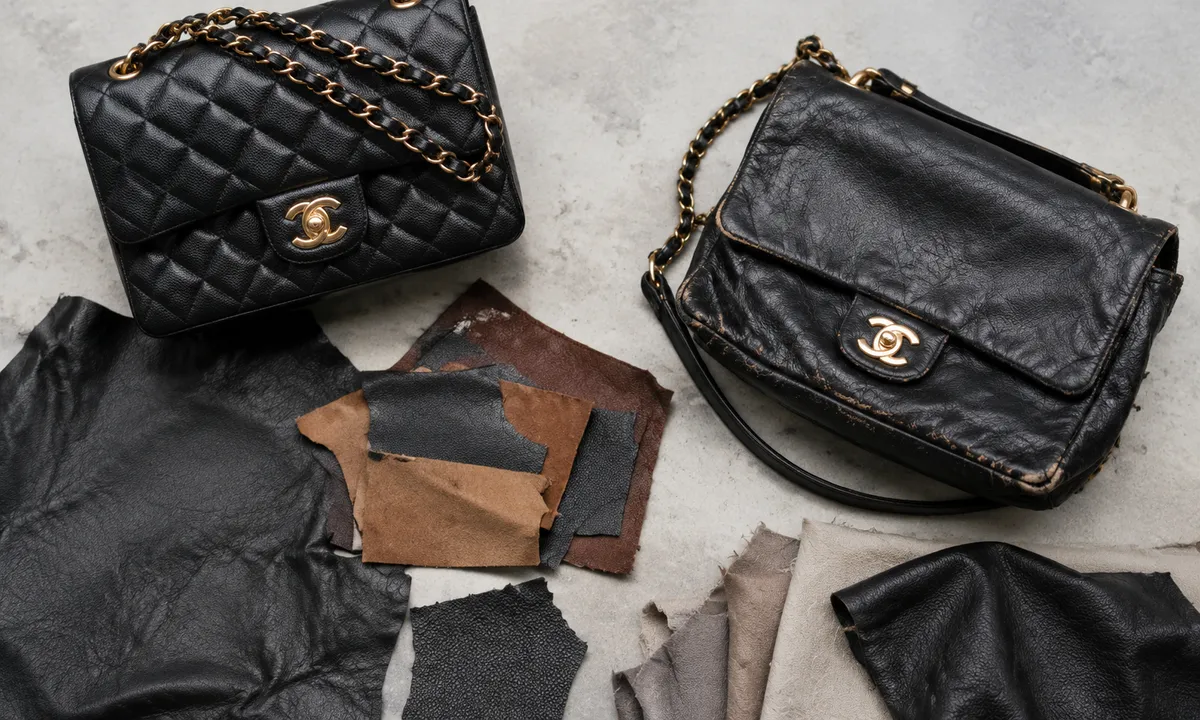
A Chanel Classic Flap sold for around 800 dollars in 1990. Today the same bag retails above 10,000 dollars, a price increase that has outrun inflation by a factor that would make a mortgage broker blush. The standard explanation from the houses is that materials and labor have gotten more expensive. That is partially true. What is left out of that explanation is more interesting.
Luxury leather goods were once engineered to outlast the person who bought them. The tanneries supplying houses like Hermes and Louis Vuitton in the mid-twentieth century worked with hides that had been vegetable-tanned over months, a slow process that produced leather dense enough to develop a patina over decades rather than peeling at the corners in three years. The stitching on a vintage Kelly bag from the 1960s is hand-sewn with linen thread, waxed and doubled back on itself so that if one stitch breaks, the line holds. Pull apart a contemporary mid-tier luxury bag and you will frequently find polyester thread, machine-stitched in a single pass. If that thread frays, the entire seam goes.
This is where the question in the title gets complicated, because the luxury market is no longer one thing.
What the Price Increase Actually Bought
Between roughly 2008 and the present, the major French and Italian houses raised prices aggressively and repeatedly. Some of this reflected genuine cost pressures: quality full-grain calfskin from European tanneries costs more than it used to, and skilled saddle-stitchers in the Hermes ateliers in the Auvergne earn real wages. But a significant portion of the price increase was strategic. Consultants and executives figured out that above a certain threshold, a higher price actually drives demand among aspirational buyers because it signals exclusivity. The bag became a financial instrument as much as a physical object, and the physical object was allowed to drift.
Canvas-backed leather, meaning a hide split thin and laminated over fabric rather than used full-thickness, became more common even in bags priced in the thousands. Hardware that looks solid brass is often zinc alloy with a plating thin enough to wear through in a year of daily use. Lining materials that once were suede or leather in houses like Celine and Gucci have become coated fabric in many current models. None of these substitutions are necessarily visible to someone examining a bag on a boutique shelf. They show up eighteen months later, in a corner crack or a zipper pull that has lost its finish.
A resale market that prices vintage bags above their original retail, which has become common for certain Hermes, Chanel, and early Bottega Veneta pieces, is partly a bet on scarcity and the logo. But it is also a quiet vote on construction. The secondary market for bags from the 1980s and 1990s remains strong because enough of those bags still work. The handles have not cracked. The closures close.
The Houses That Still Build for Permanence
Hermes is the clearest exception and the most discussed one, so it is worth being specific about why rather than just invoking the name. The Birkin and Kelly are still assembled by a single artisan from start to finish, a method called confection a la main, in workshops where the craftsperson completes every step rather than working on a production line. The leather choices, Togo, Epsom, Box Calf, Barenia, are all substantial full-grain or full-thickness hides finished in ways that are legible if you handle them. The palladium and gold hardware is solid metal. The saddle stitching is done by hand with two needles and linen thread pulled tight enough to slightly compress the leather at each hole. It is slow, expensive to produce, and it shows in the longevity. Thirty-year-old Birkins come up at auction in condition that modern bags will not replicate.
Goyard, less marketed but genuinely old, uses a coated canvas on its trunks and totes that has been made by essentially the same process since the nineteenth century. The coating is applied by hand, dot by dot, in a pattern that is specific to the house. It does not delaminate the way the cheaper heat-bonded coated canvases do, and the structure of the bags is built on wooden frames for the larger pieces, the way trunk-makers worked before luggage became soft-sided and throwaway.
Moynat, smaller and recently revived, has invested specifically in archive-based construction methods and makes much of this in its communications. Whether the revival fully matches the pre-war originals is a fair question. The current bags are well-made by any reasonable standard and use proper leather rather than splits.
These are not the majority of the luxury market. They are the top of a tier that has itself become stratified.
The Middle Range and What Happens to It
A bag priced between 1,500 and 4,000 dollars from a major European house occupies a strange position in 2025. It costs more in real terms than a similar bag from the same house cost in 2005. The marketing around it uses language about craftsmanship and heritage. The actual construction, examined closely, has often been simplified. Bags in this range from houses like Burberry, Coach at its higher end, Michael Kors Collection, and even some lines from Prada use pebbled leather that is frequently corrected grain, meaning the surface has been sanded and embossed with a texture to hide imperfections in the hide. Corrected grain leather is more uniform-looking than full grain and cheaper to source, but it wears differently: the thin coating that gives it its surface can crack or peel rather than developing the depth that full-grain leather takes on over time.
This is not fraud. The houses are not lying about what the bags are made of in most cases, though the labeling on leather type is frequently vague. It is a set of engineering decisions made under margin pressure, and it produces bags that look the part for the first couple of years and then age in ways that feel like depreciation rather than character.
The person buying a 2,500 dollar bag and expecting it to last twenty years in good condition is working from an assumption about the category that may have been accurate in 1995 and is no longer reliably true across the range.
Repair as the Real Test
One way to take the long measure of a bag’s design intentions is to ask whether the house will repair it. Hermes has a repair service, called Hermes Petit H and the broader spa service at their stores, where damaged bags are sent to the atelier and returned months later restored. This is only economically viable because the bags were designed with repair in mind: the panels are cut and finished in ways that allow them to be replaced or re-stitched without destroying adjacent structure. A bag built for planned obsolescence cannot be economically repaired because there is nothing to repair to, no return point in the construction.
Several of the mid-range houses have formally wound down or severely restricted their repair offerings over the past decade. Louis Vuitton still offers repairs on its core monogram canvas pieces, which are straightforwardly constructed, but the service on its leather lines has become more inconsistent. Gucci’s repair infrastructure has thinned. The practical consequence is that a bag in the 2,000 dollar range that develops a hardware fault or a lining tear at year four often has no good path back to function. It goes to a third-party cobbler if the owner is resourceful, or it goes in a closet.
Repairability is an honest measure of whether a manufacturer believed their object would still be in use in a decade. The answer embedded in the construction and the service network tells you more than the marketing language does.
Where This Leaves Someone Buying a Bag to Keep
The calculus for a buyer who actually wants durability is different from the one for a buyer chasing a logo or an investment. At the genuine top end, Hermes, certain Bottega Veneta pieces in full-grain intrecciato, older Celine under Phoebe Philo, and a handful of smaller makers still building in the old mode, the construction holds up to serious use. These bags age into themselves rather than out of their value. The price is real but so is what is behind it.
Below that tier, the honest approach is to inspect before buying. Check whether the leather has any visible grain structure of its own or whether it is too uniform andcoated-looking. Pull on astrap lightly and feel whether it has body or flex in the way a thick hide does. Look at where the handles attach to the body: is there realstitching through substantial leather, or is it a glued and crimped attachment that will fail under weight? Open the hardware repeatedly and feel whether it has the slight resistance of solid metal fittings or the plasticky lightness of a zinc alloy casting.
None of this is arcane knowledge. It is the kind of attention that craftspeople have applied to leather goods for centuries and that the marketing of luxury has convinced buyers to outsource to the logo. A 3,000 dollar bag from a famous house that is built to a two-year life cycle is a worse purchase than an 800 dollar bag from a small English or French saddlery that has been making the same design for forty years with full-grain bridle leather and brass rivets. The smaller maker is harder to find and does not come with a receipt from a boutique on Rodeo Drive. What it comes with is a bag that will still be holding its shape when the designer piece is in a box in a closet, its corners white and chalky, waiting on a repair service that has been discontinued.