


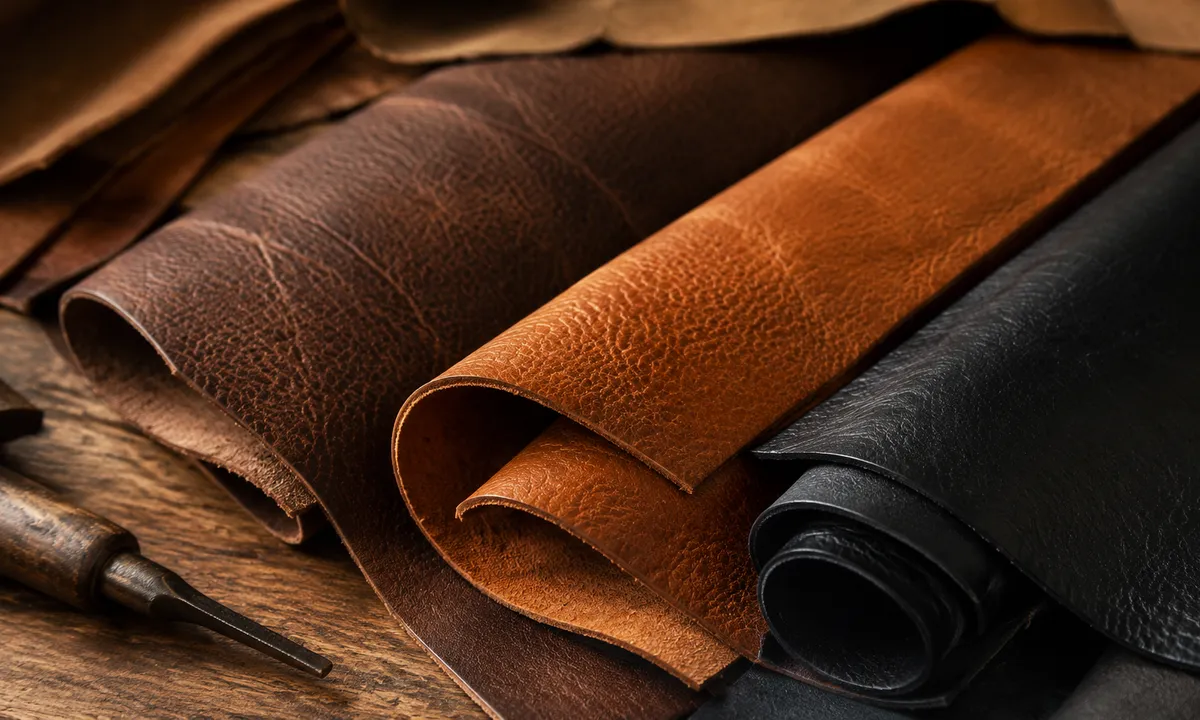
Leather has a reputation problem. Because so much of what gets sold under that name is pressed fiber board, split graincoated with polyurethane, or genuine leather in the technical-but-misleading sense, most people have spent years handling the bad stuff without knowing it. That makes real quality, when they finally encounter it, feel almost surprising, like something foreign snuck into the pile.
These seven signs are not about brand names or price tags. They are about the physical object in front of you.
The Smell Tells the Truth First
Full-grain and top-grain leather from a well-tanned hide carries a smell that is difficult to fake and easy to recognize once you know it: earthy, slightly smoky, faintly sweet. It comes from the tannins and natural oils that have penetrated the fiber structure during processing. A vegetable-tanned belt, for instance, smells almost like a forest floor after rain. A chrome-tanned leather wallet has a cleaner, more mineral scent. Both are honest.
Bonded leather smells like glue. PU-coated splits smell like plastic warming in the sun. The chemical additives used to make them look like something they are not have their own giveaway odor, especially when the piece is new or left in a warm car. Hold a wallet, bag, or belt close and take one slow breath before you commit to anything else. The nose is faster than the eye.
Grain Marks and Pore Pattern Are Not Uniform
Grain Marks and Pore Variation Are Not Uniform
A hide is skin. Skin has scars, tick bites, wrinkles, and follicle patterns that vary across different parts of the animal. On a full-grain surface you will see that variation: the pore spacing is slightly different here than there, a faint ridge runs diagonally across one corner, a tiny nick from the animal’s life shows up near an edge. None of it is symmetrical.
Embossed or printed leather, by contrast, repeats. Look closely at any two square inches and the texture pattern tiles. Sometimes the repeat is subtle, a few centimeters wide, but it is always there if you look for it. That tile is the signature of a machine, not an animal. High-quality full-grain leather has no repeat because the source material had none.
The Edge Finish Reveals How Seriously the Maker Took the Interior
Flip a piece of leather goods over and look at the cut edges. On a well-made item, those edges will be burnished smooth, painted with edge coat applied in careful layers, or folded and stitched under. The exposed cross-section on a quality hide shows tight, dense fiber. Run a fingernail along it and it feels almost solid, not crumbly.
On bonded leather or low-grade split leather, the edge tells the whole story. It crumbles at contact, or it shows a rough, woolly interior that the maker tried to hide with a single coat of dark paint. Sometimes the layers of compressed fiber dust are visible under that paint if the light hits right. Edge finishing is expensive and time-consuming, so factories cut it when the rest of the product is already cheap. A clean edge almost always means a legitimate hide.
How It Responds to Pressure and Heat
Press a thumb firmly into the surface and hold it for a second. On full-grain leather, the area around the pressure point wrinkles slightly, the way skin does. Release and the wrinkles fade slowly, leaving a faint warmth. The surface has absorbed the pressure because the fiber network is alive and flexible at the micro level.
On coated or bonded materials, the surface does not wrinkle around the pressure point. The coating is rigid relative to the compressed layer underneath, so it either dimples in isolation or resists entirely and springs back with no trace. After years of this, the coatingcracks along stress lines while the substrate beneath crumbles. That is what people mean when they say a cheap leather jacket started “peeling”: the coating was never bonded to anything that could move with it.
Warmth matters too. Real leather absorbs body heat quickly and holds it, which is why a good leather wallet feels warmer in the hand than a vinyl one of the same size. The fiber structure conducts and retains heat differently than plastic film does. It is a subtle thing, but once noticed it becomes hard to unfeel.
Stitching Consistency and Thread Depth
Good leather goods are stitched with thread that runs through the full thickness of the hide, not just through a thin topcoat. The stitches should be evenly spaced, and the thread should sit slightly below the surface of the leather, pulled down into a groove or at least lying flush, not piled on top of it. In most high-quality goods, the stitch channel is pre-cut or pricked so each hole is clean and the spacing is mechanically precise, typically somewhere between 4 and 6 stitches per centimeter depending on the weight of the hide.
Loose stitching, thread that lies on the surface like decoration, and knots visible at the ends of seams all suggest shortcuts. So does a single-needle lockstitch on a piece where the maker wanted the appearance of hand-stitching: a true hand-stitched seam uses two needles and a saddle stitch, which means if one thread breaks, the seam does not unravel. A lockstitch will. That difference is not visible to the eye, but any leather craftsperson will tell you it matters for longevity.
Patina Potential: The Surface Before It Has Aged
Some of the best leather looks almost plain when new. Vegetable-tanned full-grain in its natural state tends toward a pale tan or a muted brown, not especially glossy, with a surface that accepts a fingerprint and holds it briefly. That is the point. The oils from handling, the sunlight, the friction of daily use, all of it works into the surface over months and years and builds the patina that makes aged leather visually distinct from anything manufactured to look old.
If a piece already looks heavily treated, artificially distressed, or coated with a high-gloss finish that obscures the grain entirely, it is probably covering something. A surface that cannot age gracefully usually cannot afford to. The best leather goods often look more impressive at two years than at two weeks.
Weight and Density for the Size
A full-grain leather belt of 38 inches, at 4 ounce weight (roughly 1.6 mm thick), should feel substantial in the hand. A bifold wallet in vegetable-tanned leather, even before it is broken in, has a particular heft that a thin bonded version never matches. This is not about bulk for its own sake. It is that genuine hides have a fiber density that reads as weight, and that density is what gives the piece its structural integrity.
Pick up two items that appear similar and compare them. The one that surprises you with its weight is almost always the one built from better material. Factories producing fast, cheap goods have no incentive to use thicker hides because material cost scales directly with substance. Thinness is the default of economy, and heaviness is the artifact of quality that no coating or treatment can simulate convincingly.
A good piece of leather, bought once and maintained with a basic conditioning oil twice a year, will outlast three or four replacements of the synthetic version that looked fine at purchase. The weight you feel at the store is the same weight that will still be there in a decade.