


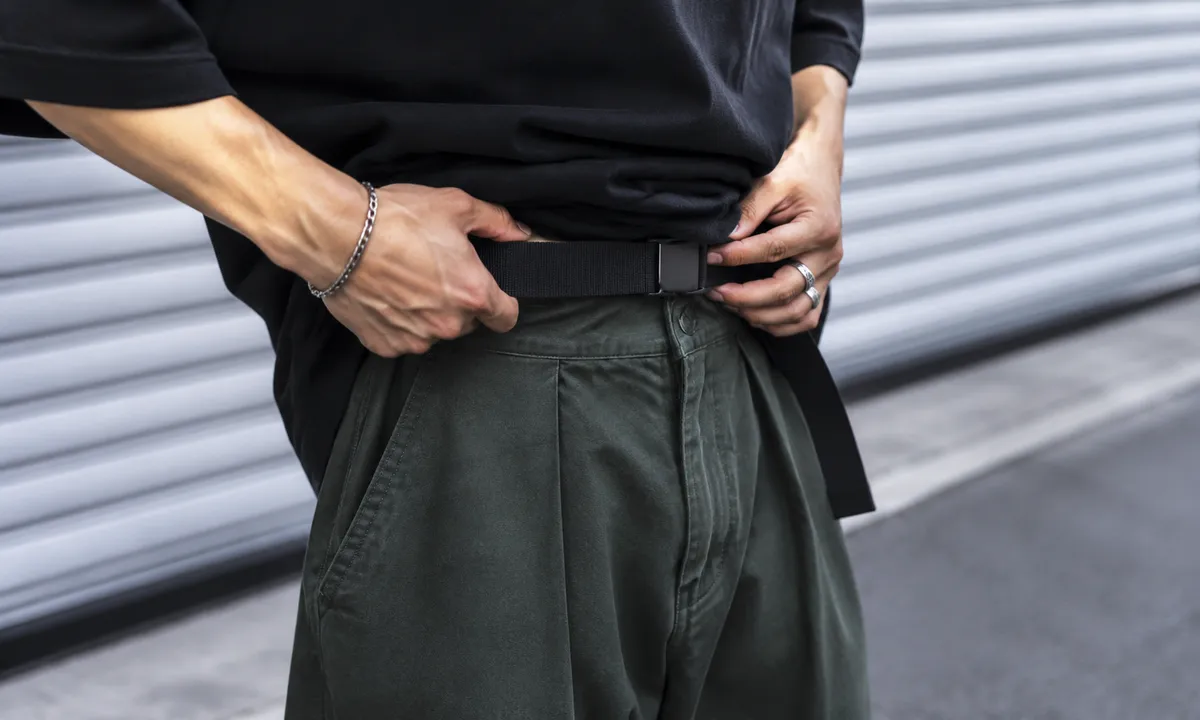
Baggy street clothes have a specific failure mode: everything looks borrowed. The pants sag in the wrong places, the oversized tee floats free, and the whole outfit reads as someone dressed in a hurry rather than someone who chose to wear loose silhouettes on purpose. The fix, almost every time, comes down to the waist.
Not because a nipped-in waist is some universal style law. It is not. The reason is structural: the human eye needs at least one visual anchor to read an outfit as intentional. When there is nothing to organize the proportions, the clothes win and the person disappears. The waist is the most reliable anchor point available, and the six tricks below work on real outfits worn by real people who are not changing their whole wardrobe to do it.
The Front Tuck That Does Not Look Staged
A full tuck flattens everything and looks fussy. The front tuck, where just the front hem of a shirt gets tucked into the waistband while the back hangs free, creates definition without commitment. The key is to tuck roughly two inches of fabric, then pull about a half inch back out so there is a slight blouse. Too flat and it reads as tucked-in dress code. The slight pull gives it an ease that looks like something that happened while getting dressed rather than something that was carefully arranged in a mirror.
This works best on oversized tees, relaxed button-downs worn open, and lightweight linen shirts. It fails on very stiff fabric, which resists the blousing and makes the whole thing look like a mistake. Soft cotton and linen are forgiving.
A Belt Worn Over an Oversized Layer
Cinching a belt over a loose top is probably the oldest trick in this list and also the most effective. A wide woven belt at natural waist height turns a boxy shirt into something with a waist. A thin leather belt worn through the loops of wide-leg pants and then pulled to a notch tighter than expected does the same thing lower, creating a pause in the silhouette that keeps the volume of the pants from taking over the whole look.
The common mistake is using a belt that matches everything perfectly. A contrasting belt, slightly thicker than seems sensible, reads more intentional than one that blends in. Tan leather on an all-grey outfit. A braided black belt on wide khakis. The contrast does part of the visual work.
The Knot Tie at the Hip
When a shirt is too long to front-tuck cleanly and too boxy to belt, knotting the hem at one hip solves both problems at once. Gather the front fabric to one side, twist it once, and knot it against itself. The knot sits just below the hip bone, slightly off-center. It lifts the hemline asymmetrically, shows a sliver of the waistband below, and creates a point of interest that breaks the baggy rectangle of the shirt.
This works on lightweight jersey, soft flannel worn open over a tank, and cotton button-downs. The knot should be small and tight, not a large puff of fabric. If it looks like a bow, it is too loose. Pull it taut and tuck any excess end under itself.
High-Waist Layering
A high-waisted skirt or trouser worn over a long tee automatically defines the waist without any knotting or tucking required. The waistband becomes the anchor, and the top can stay as loose as it wants above that line. The proportion rule is simple: if the bottom is high and full, the top should be long enough to blouse slightly over the waistband. About an inch of visible overflow looks deliberate. Four inches of overflow looks like the skirt is falling down.
The mistake here is pairing two baggy pieces of the same weight and letting them blur together. High-waist layering only rescues the outfit when the waistband line is physically clear. A structured waistband, even on a casual woven skirt, gives the eye the anchor it needs.
Bralette or Cropped Tank as a Layering Anchor
Leaving a bralette or cropped fitted tank visible under an open oversized jacket or unbuttoned flannel draws the eye to the narrowest part of the torso. The outer layer floats wide. The fitted layer underneath is doing all the structural work: it indicates where the waist actually is, so the loose piece around it reads as intentional volume rather than clothes that do not fit.
The fitted inner layer needs to end at or just above the natural waist. A cropped tank that ends at the ribcage, for instance, concentrates the attention there. A longer fitted layer that extends to the hip loses the contrast that makes the trick work. The gap between where the inner layer ends and where the outer layer hangs creates a proportional break that pulls the whole look into order.
Fabric contrast helps. A ribbed fitted tank under a nylon windbreaker gives the eye two clear visual registers to move between. A plain fitted tee under a loose linen shirt is subtler but reads the same way: tight, then loose, with a defined waist as the transition point.
Drawstrings Pulled and Tied in Front
An enormous number of street and athletic pieces have drawstrings at the waist that most people leave hanging or tie in a basic knot behind the scenes. Pulling those strings to actually cinch the garment, then tying a small bow or double knot at the center front, does two things simultaneously: it gathers the fabric to the body and adds a visible hardware detail at the waist that functions like a belt without requiring one.
This is particularly effective on oversized athletic shorts worn with a loose crewneck, or on drawstring linen trousers paired with a boxy top. The cinch does not need to be dramatic. Two inches of gathering at the sides, visible as small fabric folds pointing toward the tied front, is enough. The key is that the drawstring ends up as a front-facing detail rather than a hidden functional toggle. Moving it to the front makes it part of the outfit’s composition rather than just a size adjustment.
Streetwear pieces with thick cord drawstrings benefit especially from this. A thick cord tied in a neat knot at the center front of a pair of wide-cut cargo pants, with the tails hanging a few inches down, reads as a considered styling choice rather than a sizing workaround. The difference between sloppy and intentional is often just which direction the knot is facing.