


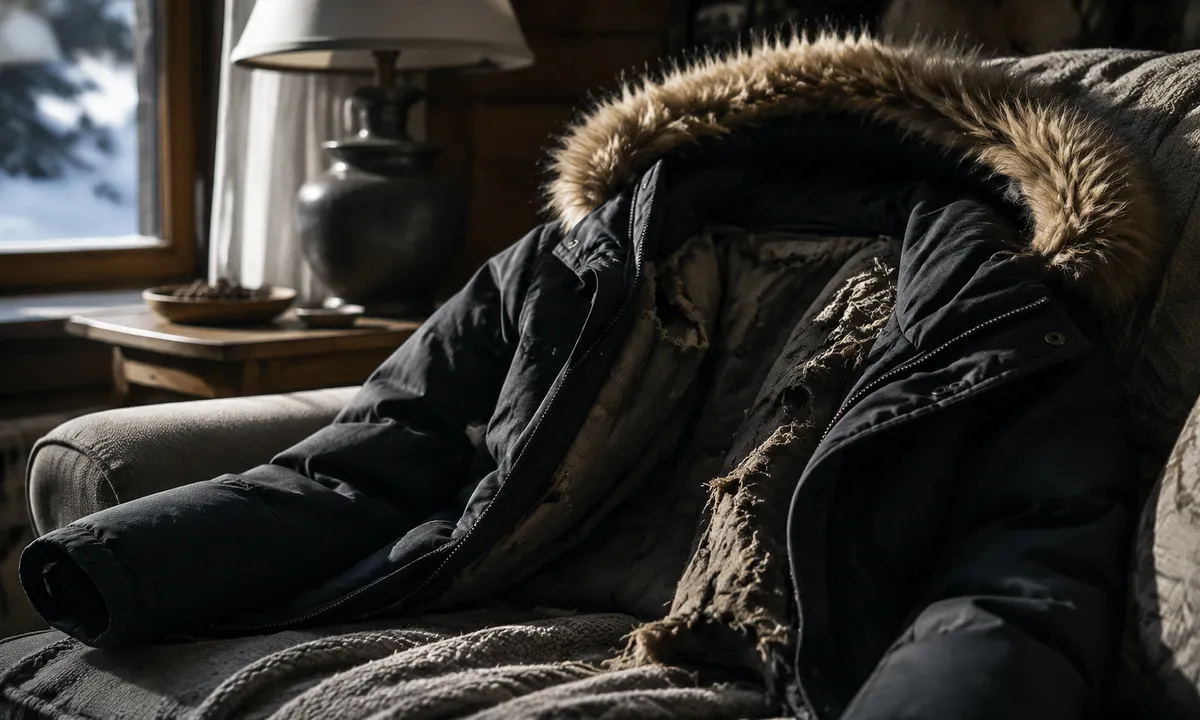
Cold is honest. It doesn’t care what the tag says or what the coat cost. It pushes through. And a lot of people wearing what they believe is a serious winter coat are, by February, simply cold.
The signs are rarely dramatic. They accumulate quietly: a shiver that won’t go away, arms crossed even indoors, the whole-body stiffness that comes from clenching against the temperature rather than moving freely through it. None of that is normal. It means the coat isn’t doing its job.
The Wind Cuts Straight Through
Insulation traps warm air. Wind strips that air away. A coat without a windproof shell or a tight-woven outer fabric is essentially a porous container: the insulation exists, but the cold can flush it out in seconds the moment a real gust hits.
The test is simple. Stand in wind. If the cold registers immediately and fully on the body beneath, not just on exposed skin but through the coat itself, the outer shell isn’t doing its part. Down insulation is particularly vulnerable to this: loose or unlaminated down jackets that feel impressively warm in a still, cold room can feel almost useless on a 25-degree day with even a moderate wind.
Lots of coats marketed as “winter” are built for cold-but-calm conditions, which is a much easier problem to solve. Wind resistance is a separate construction decision, and cheapercoats frequently skip it.
The Shoulders and Collar Leave a Gap
Cold doesn’t enter a coat through the insulation. It enters through the gaps. The collar, the cuffs, the shoulder seams, the hem: these are the architectural weak points, and how a coat handles them tells you everything about whether it was designed for serious cold or for the look of serious cold.
A collar that sits loosely around the neck is practically decorative. Cold air pours down the front of the torso the moment the wearer looks down or turns their head. A coat built for real winter has a collar that can close high and stay there, whether through a chin strap, a zip guard, or a baffled inner collar that seals without needing to be held in place. Many fashionable winter coats have wide, open collars that photograph well and perform poorly.
The shoulder area deserves equal attention. Where the sleeve meets the shoulder is often where the insulation is thinnest or least well-sealed. In very cold weather, the shoulder zone can feel almost cold to the touch while the chest stays warm. If the arms feel significantly colder than the torso, it’s often a structural issue at the seam, not a fill problem.
Warmth Disappears When You Stand Still
Movement generates heat. Walking briskly in a coat that wouldn’t otherwise hold temperature can mask a real insulation shortfall for miles. The reveal comes when someone stops: waiting at a corner, standing on a train platform, sitting on an outdoor bench. Within a few minutes, a coat with insufficient fill weight or a low-quality synthetic insulation stops adding warmth and starts simply delaying the cold rather than blocking it.
This is particularly common with synthetic fill jackets in the mid-range price category. Manufacturers have gotten good at producing synthetic insulation that feels substantial and compresses well but has a much shorter effective temperature range than its weight suggests. A jacket rated for cold conditions by the seller can feel entirely inadequate when the body isn’t generating additional heat.
The standing-still test is worth actually doing. Ten minutes outside in the coldest weather the coat is supposed to handle, at rest, with no wind. If the core starts to cool perceptibly during that window, the coat’s rated range is probably optimistic.
The Sleeves Are Too Short
Sleeve length is one of the more overlooked fit problems in winter coats, and it has real thermal consequences. A sleeve that ends at the wrist bone leaves a few centimeters of exposed skin between the coat hem and any glove. Those few centimeters are enough. Cold air at the wrist travels up the inside of the sleeve immediately, and the hand stays cold no matter how good the gloves are.
The standard recommendation in serious cold-weather gear is for sleeves to reach the thumb knuckle when the arms hang naturally, or to incorporate a thumb loop that extends the coverage. Most fashion-oriented winter coats end far short of this. The style logic makes sense: shorter sleeves look cleaner. The thermal logic is a problem the moment the temperature drops below the mid-twenties.
This is also a sizing issue. Many people size down in winter coats for a cleaner silhouette, and in doing so sacrifice two or three centimeters of sleeve. On a coat that was already borderline, that decision matters.
The Coat Handles Moisture Poorly
Insulation that gets wet loses most of its thermal value. This is not a fringe concern. Urban winter brings snow that melts on contact, sleet, wet wind, and the ambient humidity of crowded spaces followed by cold outdoor air. A coat that absorbs and holds moisture will feel progressively colder over the course of a full winter day, even if it started out warm in the morning.
Down insulation is the most sensitive to this. High-quality down treated with a durable water repellent (DWR) finish or hydrophobic down clusters holds up considerably better in wet conditions than untreated down, which clumps when wet and provides little insulation until it dries. Untreated down in a coat without a water-resistant shell is a liability in any winter climate with precipitation.
Synthetic insulation tolerates moisture better and keeps a portion of its loft even when damp, which is one genuine advantage it holds over down in wet climates. But the outer fabric still matters. A coat that soaks through at the shoulders after ten minutes in light snow is loading moisture onto whatever is beneath it, insulation included.
A quick way to check DWR performance: let water hit the outer shell. It should bead and roll off. If it soaks in and darkens the fabric, either the coating has worn away or it was never applied adequately. DWR can be restored with a wash and a tumble-dry cycle or a dedicated spray-on treatment, but a coat that never had it to begin with needs a different shell.
Fill Power Ratings and the Gap Between Spec and Experience
Down is rated in fill power, a measure of how much loft oneounce of down produces. Higher fill power means a given weight of down occupies more space, trapping more air and providing more insulation per gram. Coats at the budget end of the market often use 550 or 600 fill power; serious cold-weather gear typically starts at 700 and goes up from there.
Fill power is only half the equation. Fill weight, the total amount of down in the coat, determines actual warmth. A 900 fill power coat with very little total down will be lighter and more compressible than warm. Manufacturers sometimes emphasize the fill power number while keeping the fill weight modest, producing a coat that sounds premium but performs closer to a mid-layer. A coat with 700 fill power and 300 grams of total fill will be meaningfully warmer than one with 900 fill power and 150 grams, even though the latter sounds more impressive.
This information is usually available on the spec sheet or the label. Comparing it is worth the few minutes it takes. A coat sitting in the closet that seems inexplicably cold for what it cost is frequently a case of high fill power paired with a fill weight appropriate for autumn rather than January.
The honest version of a coat’s performance range is the one given by the fill weight, not the fill power, not the price tag, and not the description on the manufacturer’s website. The gap between those numbers and actual experience, standing outside in January waiting for a light to change, is where a lot of coats quietly fail.