


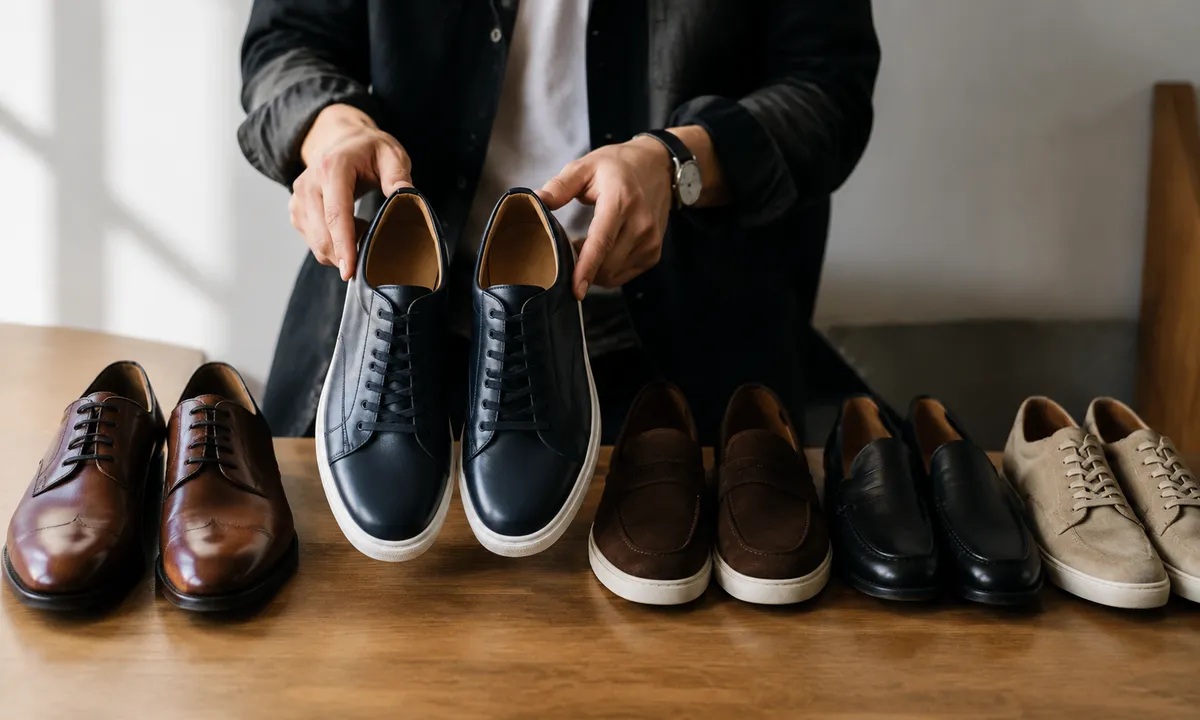
Commuter footwear is a category that barely existed in shoe retail twenty years ago, and now it quietly drives a significant slice of the market. The reason is simple: a lot of people walk further to and from transit, parking, and office lobbies than they ever walked for leisure, and they do it five days a week, fifty weeks a year, on hard concrete and steel grating, often in shoes that were designed for a desk or a dinner.
Five specific swaps can change that situation without sacrificing how a person looks getting off the train.
Dress Oxfords Swapped for Leather-Lined Sneakers
The classic dress Oxford is built for short distances between a car door and a conference room. Its leather sole is thin, its toe box is narrow, and the heel counter offers almost nothing in the way of shock absorption. An hour on pavement makes the problem obvious.
The swap is a leather or suede sneaker with a cupsole rather than a vulcanized flat sole. Brands like Koio, Greats, and Common Projects have been doing this for years, and more recently a range of mid-price labels have followed. What they offer is a silhouette that reads as polished from across a conference table but carries a few millimeters of EVA foam underfoot. The leather uppers hold a crease like a dress shoe. The laces tie the same way. The difference is felt, not seen, usually after the third block.
The one honest caveat: this swap works better with trousers that have a slight break. Slim-cropped pants expose the sneaker’s profile fully, which is either a style statement or a sore thumb depending on the office.
Pointed-Toe Heels Swapped for a Block-Heel Mule
A stiletto or a tapered pump transfers the body’s weight onto a surface roughly the size of a pencil eraser. On a subway grate or a cobblestone transition between sidewalk materials, that geometry is actively dangerous before it is merely uncomfortable.
The block-heel mule, done right, solves three of those problems at once. The heel base is wide enough to distribute pressure, the open back means slipping them off for the train is a two-second operation, and the toe box is generally rounder. The slip-on profile reads as deliberately modern rather than as a compromise. Castaner, Staud, and a number of Italian mid-range labels make versions that hit a middle register between casual and evening. The key spec to look for is heel height between 50 and 70 mm and a heel base of at least 35 mm square. Below that, it starts behaving like a kitten heel on anything but flat poured concrete.
Pairing them with wide-leg trousers or a midi skirt keeps the silhouette proportional and means no one scrutinizes the footwear at all.
Canvas Slip-Ons Swapped for Supportive Loafers
Canvas slip-ons, the flat kind with a rope or rubber sole, have almost no arch support built in. For a short errand they are fine. For a forty-minute walk with a laptop bag pulling one shoulder lower than the other, they let the foot pronate in ways that accumulate through the day. A lot of afternoon foot fatigue traces back to shoes that were comfortable for the first twenty minutes.
A well-constructed leather loafer is a different object entirely. The shank, a stiff component running lengthwise through the midsole, resists torsion. A slight heel elevation, typically around 20 mm on most dress loafers, puts the foot in a slightly more neutral position than a dead-flat sole. Brands like G.H. Bass and Cole Haan sell loafers with visible technology in the sole, which can look busy, but their less marketed leather construction lines often have the same structural support with a cleaner finish.
The loafer also transitions from commute to meeting without any bag-swap required. That alone justifies the price difference over a canvas slip-on for anyone walking more than a mile a day.
Running Shoes Swapped for Walking-Specific Shoes
Running shoes are engineered for a heel-strike gait at speed, with the foot momentarily airborne between strides. Walking never involves both feet leaving the ground. The biomechanics are different enough that a well-cushioned running shoe is not automatically the best choice for a long flat-footed commute. This is less obvious than it sounds because running shoes are thick and soft, which feels like support, but the foam is tuned for impact loading that walking simply does not generate at the same intensity.
Walking shoes, a category that lacks the marketing budget of performance running footwear, are built with a rocker geometry that assists the rolling motion from heel through ball to toe. New Balance makes a few models in this category that look presentable enough for a business-casual environment. Ecco’s walking line sits even closer to a dress shoe in silhouette. The cushioning is firmer and more evenly distributed front-to-back, which matters after the second mile.
The practical test: if someone routinely switches from running shoes into different shoes the moment they reach the office, that is a strong signal the running shoes are not serving the actual use case.
Ankle Boots With No Flex Swapped for Chelsea Boots With a Flexible Welt
Ankle boots are a commuter staple for good reason. They work with almost everything, they provide some ankle coverage in cold weather, and they look intentional rather than athletic. The problem is construction variation. Two Chelsea boots sitting side by side on a shelf can behave completely differently once worn because one has a rigid cemented sole and the other uses a Goodyear welt or a Blake stitch with a more flexible sole profile.
A rigid cemented sole on a boot does not flex at the ball of the foot, which forces the ankle to compensate for the motion the shoe will not allow. After a long commute, that compensation shows up as soreness above the Achilles rather than in the foot itself, which makes it easy to misattribute. The fix is checking sole flexibility before buying: hold the boot at the heel and toe and try to bend it. A commute-ready boot should flex noticeably without forcing it.
Clarks, Thursday Boot Company, and several Spanish cordwainers in the mid-range market make Chelsea boots with either a Blake or Goodyear construction, both of which tend to produce a more flexible and more repairable boot than cemented construction. The silhouette is identical from ten feet away. The difference is entirely underfoot.
Worth noting for anyone buying online: look for the word “leather insole” in the construction details. A leather insole molds to the foot over several weeks and eventually produces a fit that a synthetic insole never matches. That break-in period is real and mildly annoying, but what comes after it is a boot that fits one specific foot rather than a generalized last.
When the Right Shoe Depends on the Specific Commute
A commute that involves two blocks, a train, and a lobby elevator is a different physical problem than one involving a mile of broken sidewalk, a transfer, and a climb up stairs with no escalator. The swaps above are ordered roughly by how formal the context is, but the more important variable is total walking distance and surface quality.
Someone covering less than half a mile each way can get away with almost anything structurally sound. Someone covering two miles each way on mixed surfaces, including those cast-iron cellar doors that are polished smooth and genuinely slippery in rain, needs to weight traction and flexibility more heavily than heel height or silhouette. Leather soles look beautiful and age beautifully, but they have almost no grip on wet metal. A rubber half-sole applied by a cobbler costs around twenty to thirty dollars and solves the wet-grate problem without changing the shoe’s appearance from the top.
That small, unglamorous modification, a rubber half-sole on an otherwise handsome leather shoe, might be the most practical commuter upgrade on this list. It turns a dress shoe into something that can be worn confidently in October rain without the specific anxiety of feeling a foot slide an inch on a subway grate at the top of a staircase.