


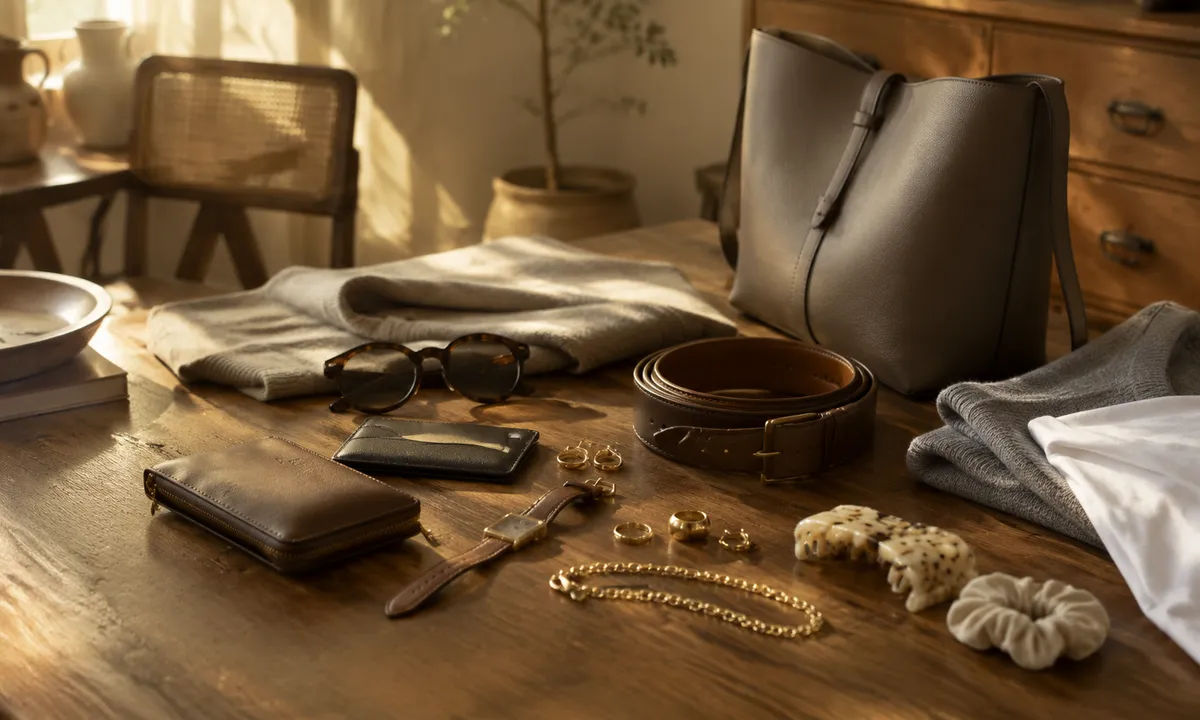
Cheap outfits and expensive outfits often share the same silhouette. What separates them is usually something small: a piece of hardware, a texture at the wrist, a strap with a little weight to it. Most people focus on the main garments and wonder why the result still looks off. The accessories are doing most of the work, and the understated ones do it best.
Not the statement ones. Not the monogrammed canvas or the logo belt. The pieces that read as expensive without announcing themselves are the ones worth knowing: leather goods with no branding, metals without shine, fabrics that hold their shape. They work because they add density to an outfit without competing with it.
A Leather Watch Strap That Actually Fits the Wrist
The watch itself matters less than people assume. A modest automatic on a well-fitted cordovan strap looks better than an expensive piece on a loose rubber band that slides around. Cordovan is waxy and stiff when new, breaks in slowly, and develops a patina that signals age rather than cheapness. Brown or dark olive reads more considered than black in a casual context. The key is fit: astrap that holds the watch snug, with the buckle sitting just past the wrist bone. That small adjustment alone changes how a t-shirt and jeans register.
A Canvas or Linen Tote with Structure
Tote bags are everywhere. The ones that look expensive are almost always the ones that stand up on their own. A bag that collapses into itself the moment it is set down reads as afterthought. Heavy canvas or treated linen, with a reinforced base and handles short enough to sit at the forearm rather than dangle at the thigh: that silhouette adds intention to a plain outfit. No logo necessary. The quality of the fabric and the way it holds form does the work.
Wool or Cashmere Socks, Visible or Not
This one sounds like a private joke, because no one is looking at socks. Except they are, constantly, and the brain processes the quality of a material even when the eye is not consciously registering it. A chunky knit wool sock in oatmeal or forest green, worn with a low-profile sneaker or a derby shoe, adds a layer of texture that changes the whole lower half of a look. It also sits at the ankle in a way that cheap cotton-polyester socks do not: with actual body. The pair costs more and lasts years longer. The math on that one is obvious.
A Matte Metal Money Clip or Card Holder
A fat wallet in a back pocket is a lumpy distraction. A slim card holder or a brushed steel money clip that slides into a front pocket disappears and keeps the line of the trouser or jean clean. Brushed steel, oxidized brass, or darkened titanium: all of them have a low-key permanence that polished chrome does not. The material costs a little more upfront and never looks worse with use. A good one bought ten years ago would still look right today.
Reading Glasses With a Considered Frame
For anyone who wears them: the frame shape and material matter more than most people allow for. Thin acetate in a tortoise or a translucent warm brown, with a profile that sits close to the face, reads completely differently than a pair with thick shiny arms and a generic shape. The glasses are on the face, which is where the eye goes first. A frame that is slightly interesting without being eccentric upgrades everything from a plain crewneck to a weekend button-down. The cost difference between a generic frame and a considered one is smaller than expected.
A Braided or Woven Leather Belt
The braided leather belt is one of those accessories that has been around long enough to feel specific rather than trendy. It works in dark brown or cognac, worn with chinos, straight-leg jeans, or linen trousers. The texture breaks up the waistline in a way a plain strap does not, and because the weave tightens and adjusts without punched holes, it always sits flat. The hardware should be simple: a small roller buckle in a metal that echoes something else in the outfit. Matching the belt hardware to the watch case or glasses frame is a finishing move that reads as deliberate without requiring any visible effort.
A Linen or Silk Pocket Square, Flat-Folded
Only in the context of a casual blazer or an unstructured sport coat. A pocket square that has been puffed or fanned reads as trying very hard. Flat-folded, so just a sliver of white or pale blue shows above the pocket, it reads as the opposite. The effect is a slight formalization of an otherwise relaxed outfit, which is exactly the right direction. A square of decent linen goes for a few dollars and lasts indefinitely. The gesture is old-fashioned in a way that has circled back around to interesting.
A Simple Chain Bracelet in a Single Metal
Not stacked, not layered with leathercords. One chain, one metal, on one wrist. A flat curb chain or a simple anchor link in sterling or gold-fill, worn loose enough to move but not so loose that it slides to the elbow. The restraint is everything. A single well-proportioned chain on a bare wrist communicates ease in a way that a cluster of mixed materials does not. The piece can cost almost nothing if the quality of the metal is decent; what matters is the proportion and the singularity of the gesture.
A Baseball Cap in a Natural Fabric
The structured foam-front trucker hat reads as a souvenir. A six-panel cap in heavyweight cotton twill, washed canvas, or wool felt reads as something else entirely. The crown should be unstructured but not collapsed, the brim flat or with only a slight curve, and the color should be a solid or a very subtle texture: navy, stone, olive, off-white. No large embroidery on the front, or if there is a small detail, something minimal. The difference in how these sit on the head is dramatic. The second kind settles and stays; the first kind rides up and shifts around all day.
A Ceramic or Stone-Faced Watch with a Plain Dial
Back to the wrist, because the wrist is that important. A second consideration, separate from the strap: the dial itself. A clean white or cream dial with minimal text, no date window, and a case diameter under 40 mm reads as quieter and more confident than a busy dial with multiple complications and a thick bezel. Ceramic cases scratch less and photograph with a flatness that reads as quality. The watch does not need to be expensive. It needs to look like it was chosen rather than grabbed. That is the distinction that registers from across a table, which is ultimately where most of these accessories are seen.